
A Clockwork Orange (1971): Movie Review
A Clockwork Orange (1971): Movie Review
Stanley Kubrick’s dystopian masterpiece remains one of cinema’s most provocative and controversial films
Introduction
A Clockwork Orange is a 1971 dystopian crime film adapted, produced, and directed by Stanley Kubrick, based on Anthony Burgess’s 1962 novel. More than five decades after its release, this film continues to spark debate, analysis, and visceral reactions from audiences worldwide. A Clockwork Orange stands as a towering achievement in cinema that forces viewers to confront uncomfortable questions about free will, government control, and the nature of evil itself.
The film’s enduring relevance speaks to Kubrick’s visionary approach to filmmaking and his ability to create works that transcend their era. A Clockwork Orange operates on multiple levels—as a satirical social commentary, a philosophical meditation on choice and morality, and a technical showcase of innovative cinematography and design.
Plot Summary and Narrative Structure
The Story of Alex DeLarge
Alex (Malcolm McDowell), the central character, is a charismatic, anti-social delinquent whose interests include classical music (especially that of Beethoven), committing rape, theft, and “ultra-violence”. The narrative follows Alex’s journey through three distinct acts:
- The Criminal Phase: Alex leads his gang of “droogs” through a series of increasingly violent crimes
- The Imprisonment and Treatment: After being arrested for murder, Alex undergoes experimental psychological conditioning
- The Return to Society: Alex emerges “cured” but defenseless, becoming a victim himself
The film’s structure mirrors a classical tragedy, with Alex serving as both protagonist and antagonist. Kubrick’s adaptation streamlines Burgess’s novel while maintaining its core philosophical questions about the relationship between choice and morality.
Narrative Innovations
A Clockwork Orange employs several groundbreaking narrative techniques:
• First-person narration: Alex directly addresses the audience, creating an uncomfortable intimacy • Nadsat language: The invented slang creates linguistic immersion while distancing viewers from the violence • Symmetrical structure: The film’s three acts mirror each other, with Alex as perpetrator, victim, and political pawn
Character Analysis
Malcolm McDowell as Alex DeLarge
Malcolm McDowell was born Malcolm John Taylor on 13 June 1943 in Horsforth, West Riding of Yorkshire, and his portrayal of Alex DeLarge became the defining role of his career. The American Film Institute rated Alex the 12th-greatest film villain of all time, testament to McDowell’s magnetic and disturbing performance.
McDowell’s Performance Elements: • Charismatic menace: He makes Alex simultaneously charming and repulsive • Physical comedy: His exaggerated movements and expressions add dark humor • Emotional range: From gleeful violence to vulnerable victimhood • Classical music appreciation: Alex’s love of Beethoven humanizes an inhuman character
The song does not appear at all in the book, as it was an improvisation by actor Malcolm McDowell when Kubrick asked him if he could dance on the fifth day of filming the scene, after complaining that the rape scene was too “stiff”. This improvisation of “Singin’ in the Rain” became one of cinema’s most disturbing juxtapositions of joy and horror.
Supporting Cast Excellence
Adrienne Corri as Mrs. Alexander
Adrienne Corri (born Adrienne Riccoboni; 13 November 1931 – 13 March 2016) was a Scottish actress who delivered a powerful performance in a challenging role. Corri, not originally cast in the film, was offered the role after two actresses had already withdrawn from the production, highlighting the film’s controversial nature even during production.
Corri’s career highlights included: • Jean Renoir’s “The River” (1951) • David Lean’s “Doctor Zhivago” (1965) • Multiple horror and suspense films throughout the 1950s-1970s
The Droogs and Authority Figures
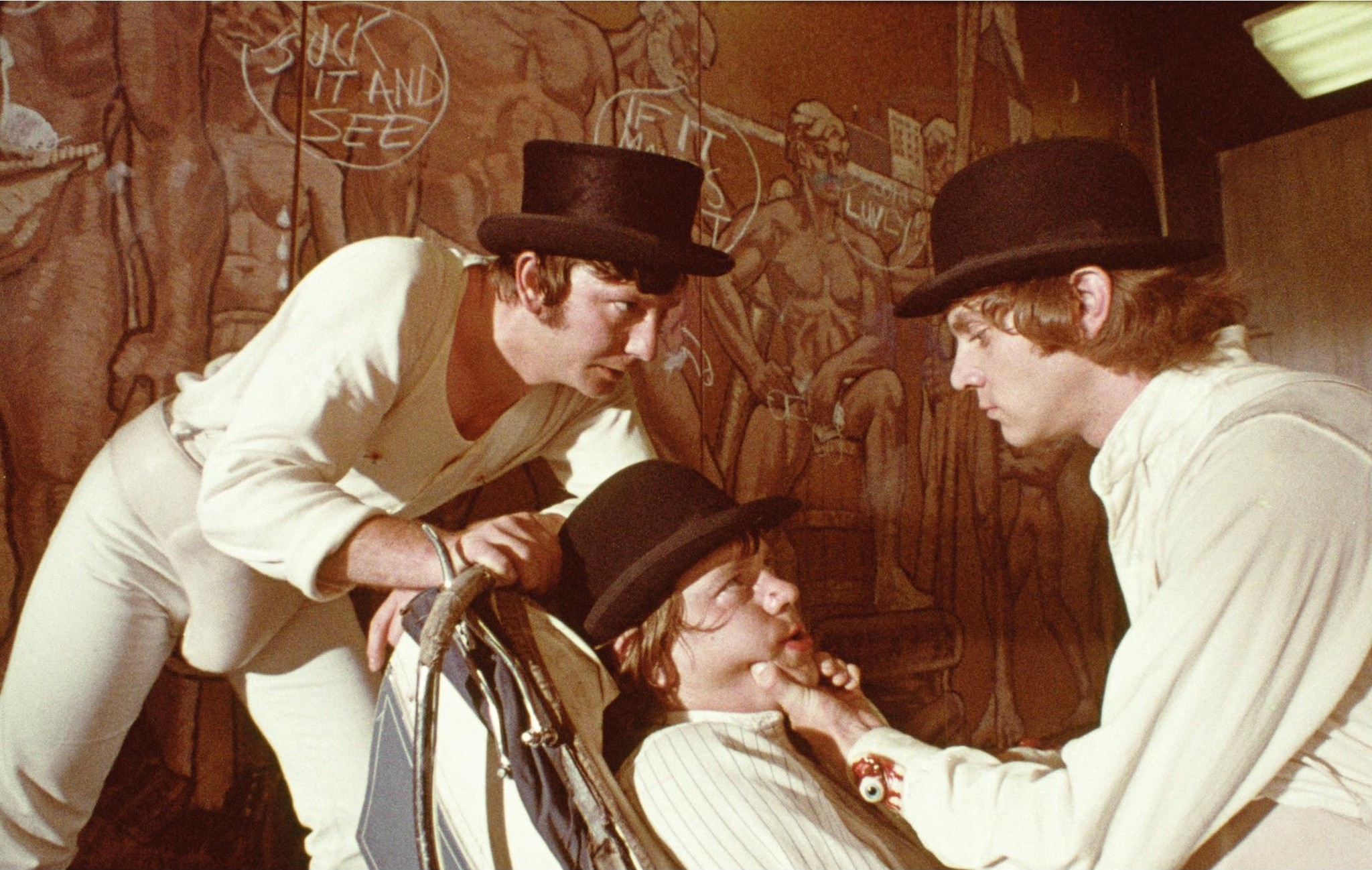
He leads a small gang of thugs, Pete (Michael Tarn), Georgie (James Marcus), and Dim (Warren Clarke), whom he calls his droogs. Each actor brings distinct personality to their role:
• Warren Clarke as Dim: The brutish follower who later becomes Alex’s tormentor • James Marcus as Georgie: The ambitious droog who challenges Alex’s leadership • Michael Tarn as Pete: The quieter member who eventually leaves the gang
The authority figures, including Patrick Magee as the writer Frank Alexander and Michael Bates as the Chief Guard, represent different aspects of institutional power and its corruption.
Visual Style and Cinematography
Kubrick’s Aesthetic Vision
A Clockwork Orange showcases Kubrick’s meticulous attention to visual detail and innovative cinematography. The film’s distinctive look creates a future that feels both alien and familiar.
Key Visual Elements: • Symmetrical compositions: Kubrick’s trademark precise framing • Wide-angle lenses: Distorted perspectives that enhance the surreal atmosphere • Bold color palette: Stark whites, vibrant reds, and clinical blues • Futuristic production design: John Barry’s sets blend modern and classical elements
Iconic Imagery
The film contains numerous unforgettable visual moments:
• The Korova Milk Bar: With its female mannequin furniture • Alex’s bedroom: A shrine to violence and classical music • The Ludovico treatment: Eyes held open with speculums • The final shot: Alex’s knowing smile to the camera
Musical Score and Sound Design
Classical Music as Narrative Device
Music plays a crucial role in A Clockwork Orange, serving both as character development and thematic commentary. The main theme is an electronic arrangement of a short excerpt from Henry Purcell’s Music for the Funeral of Queen Mary, and the soundtrack has two of Edward Elgar’s Pomp and Circumstance Marches.
Musical Highlights: • Beethoven’s Ninth Symphony: Alex’s obsession becomes his torture • “Singin’ in the Rain”: Perverted from joy to menace • Electronic adaptations: Classical pieces reimagined for synthesizer • Rossini’s “William Tell Overture”: Accompanying the high-speed sex scene
The film’s use of classical music creates cognitive dissonance, forcing audiences to associate beautiful compositions with horrific violence.
Themes and Social Commentary
Free Will vs. Conditioning
The central philosophical question of A Clockwork Orange concerns whether forced goodness has any moral value. The Ludovico Technique represents society’s desire for simple solutions to complex problems.
Key Questions Raised: • Is a person truly good if they have no choice but to be good? • Does society have the right to fundamentally alter someone’s personality? • Can evil be eliminated through scientific means? • What happens when political expedience trumps moral considerations?
Government Control and Individual Liberty
The film presents a dystopian vision where the state exercises total control over its citizens. The government’s treatment of Alex reflects broader themes about authoritarianism and the manipulation of public opinion.
Youth Culture and Social Decay
A Clockwork Orange examines the breakdown of traditional social structures and the emergence of violent youth subcultures. The film suggests that societal decay creates monsters like Alex while simultaneously condemning the systems that attempt to control them.
Cultural Impact and Controversy
Initial Reception and Banning
After it was cited as having inspired copycat acts of violence, the film was withdrawn from British cinemas at Kubrick’s behest, and it was also banned in several other countries. This controversy ironically enhanced the film’s reputation and cultural significance.
Reasons for Controversy: • Graphic violence: Particularly the home invasion sequences • Sexual assault: The treatment of these scenes as entertainment • Moral ambiguity: The film’s refusal to provide clear moral guidance • Copycat concerns: Real-world violence allegedly inspired by the film
Critical Reevaluation
In the years following, the film underwent a critical re-evaluation and gained a cult following. It received several awards and nominations, with four nominations at the 44th Academy Awards, including Best Picture.
Awards and Recognition: • Four Academy Award nominations including Best Picture • Golden Globe nomination for Malcolm McDowell • Preservation in the National Film Registry (2020) • AFI rankings: Multiple appearances on greatest films lists
Technical Achievements
Production Innovations
Filming took place between September 1970 and April 1971, during which Kubrick employed several innovative techniques:
Notable Technical Elements: • Real locations: Used actual buildings and spaces for authenticity • Practical effects: Minimal use of optical effects for realistic impact • Natural lighting: Kubrick’s preference for available light sources • Lens experimentation: Wide-angle lenses for distorted perspectives
Behind-the-Scenes Challenges
During the filming of the Ludovico technique scene, McDowell scratched a cornea and was temporarily blinded. The doctor standing next to him in the scene, dropping saline solution into Alex’s forced-open eyes, was a real physician present to prevent the actor’s eyes from drying.
These production challenges highlight Kubrick’s commitment to authenticity and his demanding directorial approach.
Legacy and Influence
Cinema’s Lasting Impact
A Clockwork Orange continues to influence filmmakers and artists decades after its release. Its visual style, narrative structure, and thematic content have inspired countless works across multiple media.
Areas of Influence: • Visual aesthetics: The film’s distinctive look appears in music videos, advertisements, and other films • Narrative techniques: First-person narration and unreliable protagonists • Character archetypes: The charismatic villain protagonist • Social commentary: Dystopian futures that reflect contemporary concerns
Contemporary Relevance
The film’s themes remain startlingly relevant in an era of increasing government surveillance, social control, and debates about criminal justice reform. Questions about rehabilitation versus punishment, individual rights versus collective security, and the role of choice in moral behavior continue to resonate.
For those interested in exploring financial themes in cinema, including how films like A Clockwork Orange have influenced market trends and cultural economics, HablemosMoney offers insightful analysis of entertainment industry impacts.
Critical Analysis
Strengths
A Clockwork Orange succeeds on multiple levels:
• Philosophical depth: Raises profound questions without providing easy answers • Visual innovation: Creates a unique and memorable aesthetic • Performance excellence: Particularly McDowell’s tour-de-force portrayal • Cultural significance: Continues to provoke discussion and analysis • Technical mastery: Showcases Kubrick’s directorial expertise
Criticisms and Limitations
The film faces several legitimate criticisms:
• Violence against women: The treatment of female characters as victims • Moral ambiguity: Some argue the film glorifies the violence it purports to condemn • Accessibility: The Nadsat language and challenging content limit its audience • Controversy overshadowing artistry: The film’s notoriety sometimes eclipses its artistic merits
Comparative Context (A Clockwork Orange)
Place in Kubrick’s Filmography
A Clockwork Orange occupies a unique position in Stanley Kubrick’s body of work. Following the philosophical grandeur of “2001: A Space Odyssey” and preceding the horror of “The Shining,” it represents Kubrick’s most direct engagement with contemporary social issues.
Kubrick’s Evolution: • Early works: Focus on war and human nature • Middle period: Exploration of technology and society • Later films: Investigation of psychological horror and historical themes
Influence on Science Fiction Cinema
The film helped establish many conventions of dystopian cinema that persist today. Its vision of youth culture, government control, and social decay influenced numerous subsequent works, from “Blade Runner” to “The Matrix” to “Black Mirror.”
For comprehensive film analysis and industry insights, the British Film Institute provides extensive resources on cinema’s cultural impact and artistic evolution.
Conclusion (A Clockwork Orange)
A Clockwork Orange remains Stanley Kubrick’s most controversial and perhaps most important film. Its exploration of free will, government control, and the nature of evil continues to resonate with audiences more than fifty years after its release. While the film’s graphic content and moral ambiguity make it challenging viewing, its artistic achievements and philosophical depth ensure its place among cinema’s greatest works.
The film succeeds not because it provides answers to the complex questions it raises, but because it forces viewers to confront these questions themselves. In an era of increasing polarization and simplified solutions to complex problems, A Clockwork Orange serves as a reminder that human nature and social organization resist easy categorization or control.
In 2020, the film was selected for preservation in the United States National Film Registry by the Library of Congress as being “culturally, historically, or aesthetically significant”. This recognition confirms what critics and audiences have long understood: A Clockwork Orange is more than entertainment—it’s a work of art that challenges, disturbs, and ultimately enlightens.
Final Thoughts (A Clockwork Orange)
Whether viewed as a cautionary tale about government overreach, a meditation on the nature of choice, or simply as a masterpiece of cinematic artistry, A Clockwork Orange demands to be seen and discussed. It remains as relevant today as it was upon its release, a testament to Kubrick’s vision and the enduring power of challenging cinema to provoke thought and inspire debate.
Rating: 9.5/10 – A masterpiece of cinema that transcends genre limitations to achieve lasting artistic significance.
Leave a Reply