
All in the Family (1979) Complete TV Review
All in the Family (1979) Complete TV Review
Introduction: A Television Revolution
All in the Family premiered on CBS on January 12, 1971, and concluded on April 8, 1979, spanning nine groundbreaking seasons with a total of 205 episodes. Based on the British sitcom Till Death Us Do Part, All in the Family was produced by Norman Lear and Bud Yorkin. It starred Carroll O’Connor, Jean Stapleton, Sally Struthers, and Rob Reiner. This revolutionary sitcom didn’t just entertain audiences—it transformed television forever, proving that comedy could tackle serious social issues while still making people laugh.
The show became the most watched show in the United States during summer reruns of the first season and topped the yearly Nielsen ratings from 1971 to 1976, the first television series to have held the position for five consecutive years. What made All in the Family so special wasn’t just its popularity, but its unprecedented willingness to address controversial topics that had never been explored on network television comedy before.
The Core Cast: Unforgettable Performances
Carroll O’Connor as Archie Bunker
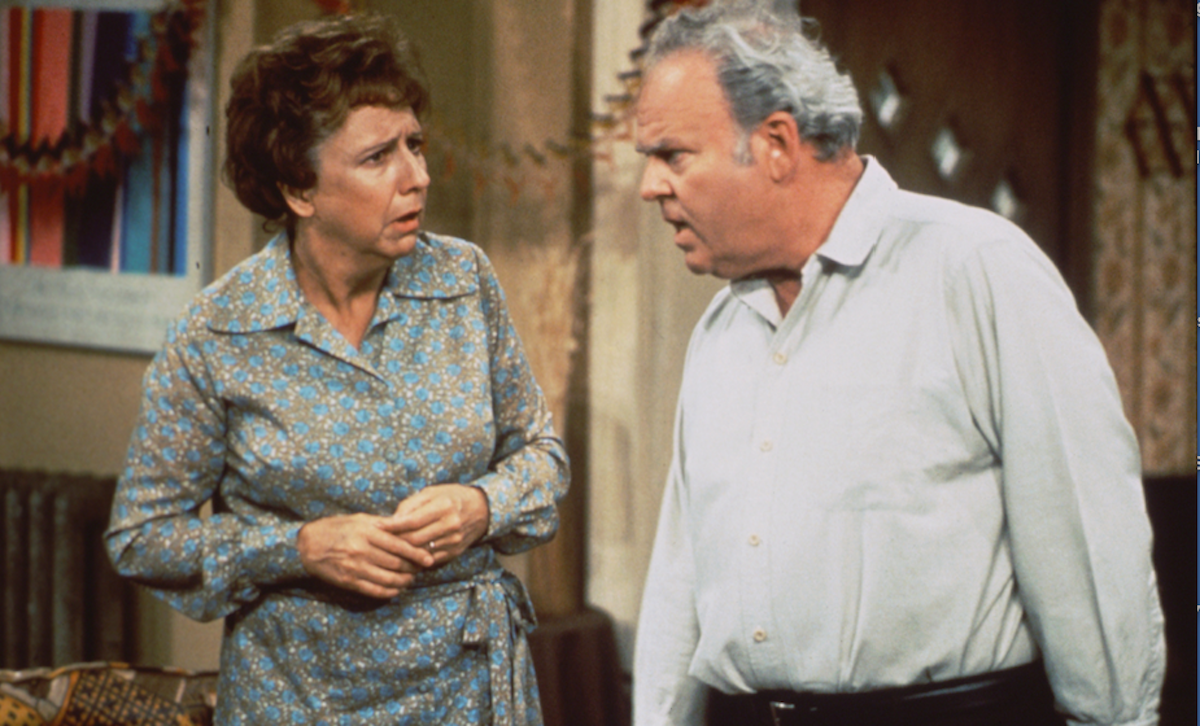
Carroll O’Connor found widespread fame as Archie Bunker, for which he won four Emmy Awards. Frequently called a “lovable bigot”, Archie is an assertively prejudiced blue-collar worker. A World War II veteran, Archie longs for better times when people sharing his viewpoint were in charge. O’Connor’s masterful portrayal brought humanity to a character who could have easily been irredeemable. Former child actor Mickey Rooney was Lear’s first choice to play Archie, but Rooney declined the offer because of the strong potential for controversy.
The genius of O’Connor’s performance lay in his ability to make Archie simultaneously deplorable and sympathetic. His character’s bigotry was always the target of the show’s humor, never its source of approval.
Jean Stapleton as Edith Bunker
Jean Stapleton played Archie’s wife, Edith, who was sweet and understanding, which can make her appear naive and uneducated. Her husband often treats her dismissively and uses disparaging language, calling her “dingbat.” Stapleton developed Edith’s distinctive voice. Stapleton remained with the show through the original series run but decided to leave at that time.
Stapleton’s Edith was far from the simple-minded character Archie believed her to be. Her innocence often revealed profound wisdom, and her gentle nature frequently served as the moral compass of the household. Stapleton appeared in all but four episodes of All in the Family.
Sally Struthers as Gloria Bunker-Stivic
Sally Struthers played Gloria, who is generally kind and good-natured like her mother but displays traces of her father’s stubbornness and temper. Unlike them, she is a feminist. Sally Struthers played Gloria Stivic in the hit ’70s sitcom “All in the Family,” which centered on a working-class family, aired from 1971 until 1979.
During early seasons of the show, Struthers was known to feel discontented with how static her part was, and in 1974, she sued to get out of her contract, but the character became more developed, thereby satisfying her. Gloria served as the bridge between generations, often caught between her father’s traditional views and her husband’s progressive ideals.
Rob Reiner as Michael “Meathead” Stivic
Rob Reiner played Michael Stivic—referred to as “Meathead” by Archie—whose values are likewise influenced and shaped by the counterculture of the 1960s. Gloria’s Polish-American hippie husband is part of the counterculture of the 1960s. While good-hearted and well-meaning, he constantly spars with Archie and is equally stubborn.
As discussed in All in the Family retrospectives, Richard Dreyfuss sought the part, but Norman Lear ultimately cast Reiner. Harrison Ford turned down the role, citing Archie Bunker’s bigotry. Reiner’s Mike represented the changing values of younger Americans, creating the perfect foil for Archie’s outdated worldview.
Seasons Overview: Nine Years of Television History
Seasons 1-2 (1971-1972): Finding Its Voice
All in the Family debuted on CBS on January 12, 1971, and it hit the ground running. The Norman Lear-created sitcom finished its first season as the #34 show in the country, but jumped to number one in its second season — a spot it held on to for the following four seasons.
The early seasons established the show’s groundbreaking format. Until All In The Family, specific political references were rare on sitcoms, so viewers got a thrill from two characters bickering over the merits of Franklin D. Roosevelt and Richard Nixon, just as real families did. Episodes like “Judging Books by Covers” addressed homophobia, while “Lionel Moves into the Neighborhood” tackled racism head-on.
Seasons 3-4 (1972-1974): Peak Popularity
These seasons contained some of the series’ most memorable episodes. The episode “Sammy’s Visit” was ranked number 13 on TV Guide’s 100 Greatest Episodes of All Time. Guest star Sammy Davis, Jr. plays himself in the episode. Davis leaves a briefcase behind in Archie’s taxi and goes to the Bunker home to pick it up. At the moment the picture is taken, Davis suddenly kisses a stunned Archie on the cheek.
Season 4 introduced the character of Maude Findlay, Edith’s cousin, played by Bea Arthur. Edith’s stridently liberal cousin Maude quickly got a spin-off—Maude—on the basis of this episode.
Seasons 5-6 (1974-1976): Social Issue Dominance
During the show’s sixth season, starting on December 1, 1975, CBS began airing reruns on weekdays at 3 p.m. (EST), replacing long-running soap opera The Edge of Night. These seasons featured increasingly complex storylines addressing abortion, menopause, and sexual assault.
Season 6 introduced Beverly LaSalle, one of the first drag queens on American television. The character, Beverly LaSalle, played by Lori Shannon, influenced Archie’s perspective on the queer community.
Seasons 7-8 (1976-1978): Cast Changes and Evolution
At the end of the eighth season in 1978, Reiner and Struthers left the series to pursue other projects. These seasons dealt with Mike’s graduation from college and the couple’s preparation for their move to California.
For the show’s final season, the practice of being taped before a live audience changed to playing the already taped and edited show to an audience and recording their laughter to add to the original sound track.
Season 9 (1978-1979): A Graceful Conclusion
The 1979 series finale was watched by over 40 million viewers. The final season focused on Archie and Edith’s adjustment to life without Mike and Gloria, while introducing new characters like young Stephanie Mills. Season 9 of All in the Family premiered on September 24, 1978 and concluded with “Too Good Edith” on April 8, 1979.
Breaking New Ground: Social Issues and Controversies
Racism and Bigotry
The show broke ground by introducing challenging and complex issues into mainstream network television comedy: racism, antisemitism, infidelity, homosexuality, women’s liberation, rape, religion, miscarriage, abortion, breast cancer, the Vietnam War, menopause, divorce, and impotence.
The Bunker patriarch was unapologetically racist, sexist, and xenophobic. He based his belief in men’s superiority to women on a mistranslation of the Book of Genesis, repeatedly argued in favor of racial segregation, and took great pleasure in throwing the word “homosexual” around as an insult.
Women’s Rights and Gender Roles
All in the Family consistently challenged traditional gender roles. In the episode “Edith’s Problem,” Edith is going through menopause, which gives her hot flashes and also lets out, in short bursts, all the pent-up frustrations she has with Archie. This groundbreaking episode earned the show one of its Emmy Awards for writing.
LGBTQ+ Representation
The show was revolutionary in its portrayal of LGBTQ+ characters. Beverly LaSalle first appeared during All in the Family’s sixth season, titled “Archie the Hero.” While some of the language used to discuss Beverly’s sexuality is outdated, the episode shines, as most of its content is far more advanced than most other shows, both in that era and in more recent shows.
Cultural Impact and Legacy
Television Revolution
While other shows featured surface-level plots, All in the Family’s storylines often involved deeper discussions of racism, women’s rights, the Vietnam War, homosexuality, rape and more. These were stories that, despite claiming to be set in the United States, actually took place in an alternate dimension, one where conflict could not be anything but the result of miscommunication.
Critic Dwight Newton said of this show, All in the Family, “In one half hour, CBS destroyed old taboos and liberated comedy writing.”
Awards and Recognition
The All in the Family TV show won an amazing number of awards during its nine seasons on the air including eight Golden Globes and twenty-two Emmys! All in the Family became the first sitcom to win Primetime Emmy Awards for all four of the lead actors (Carroll O’Connor, Jean Stapleton, Sally Struthers, and Rob Reiner).
TV Guide’s 50 Greatest TV Shows of All Time ranked All in the Family as number four. Bravo also named the show’s protagonist, Archie Bunker, TV’s greatest character of all time.
Spin-offs and Franchise Success
The success of All in the Family spawned multiple spin-offs. The second and longest-lasting spin-off of All in the Family was The Jeffersons. Debuting on CBS in January 1975, The Jeffersons lasted 11 seasons and 253 episodes. Other successful spin-offs included Maude and Good Times.
Production Notes and Behind-the-Scenes
Creative Development
“I had a father who was a bit of an Archie Bunker,” says Norman Lear, who created the show. Lear says his father would use racist terms for Chinese people and Black people. Norman Lear actually based the character of Archie Bunker on his father Herman. His father was basically a good man, but he was very prejudiced like Archie was.
Casting Challenges
Before the show reached such great heights, it shot three pilots — two of which never aired. That show, called Those Were the Days, was filmed in early 1969, and again starred O’Connor and Stapleton — but Gloria had been recast with Candy Azzara, while her husband (now called Dickie), was played by Chip Oliver.
Performance and Audience
Throughout its run, Norman Lear took pride in the fact that canned laughter was never used; the laughter heard in the episodes was genuine. All in the Family was the first TV series that allowed their viewers to hear a toilet flushing.
Strengths and Weaknesses
Strengths:
• Groundbreaking social commentary that addressed previously taboo subjects • Exceptional performances from all four lead actors • Intelligent writing that balanced humor with serious social issues • Cultural impact that influenced television for decades • Authentic character development over nine seasons
Weaknesses:
• Some episodes feel dated by today’s standards • Uneven quality in later seasons after cast departures • Certain storylines may be difficult to watch for modern audiences • Language and attitudes that were controversial even for their time
Final Verdict
Norman Lear’s “All In The Family” is the best, TV’s greatest sitcom, and the greatest show in the sixty year history of television. All in the Family stands as one of television’s most important achievements, a show that dared to use comedy as a vehicle for social change. While some aspects may feel uncomfortable to modern viewers, the series’ willingness to confront America’s prejudices head-on remains as relevant today as it was in the 1970s.
The show’s legacy extends far beyond its nine-season run. It proved that audiences were hungry for authentic storytelling that reflected their real experiences and concerns. For anyone interested in understanding how television evolved from simple entertainment to meaningful social commentary, All in the Family is essential viewing.
For those seeking more comprehensive reviews of classic television series and films, HablemosMoney offers in-depth analysis of entertainment that shaped our culture. Additionally, the Television Academy’s official recognition of the show’s numerous Emmy wins speaks to its enduring impact on the medium.
Rating: 9/10 – A television masterpiece that changed the medium forever, despite some elements that haven’t aged gracefully.
All in the Family remains a testament to the power of television to challenge, entertain, and ultimately transform society. Nearly five decades after its debut, the Bunker family continues to offer lessons about prejudice, family, and the ongoing struggle for social progress in America.
Leave a Reply