
The Greatest Show on Earth (1952): Movie Review
The Greatest Show on Earth (1952): Movie Review
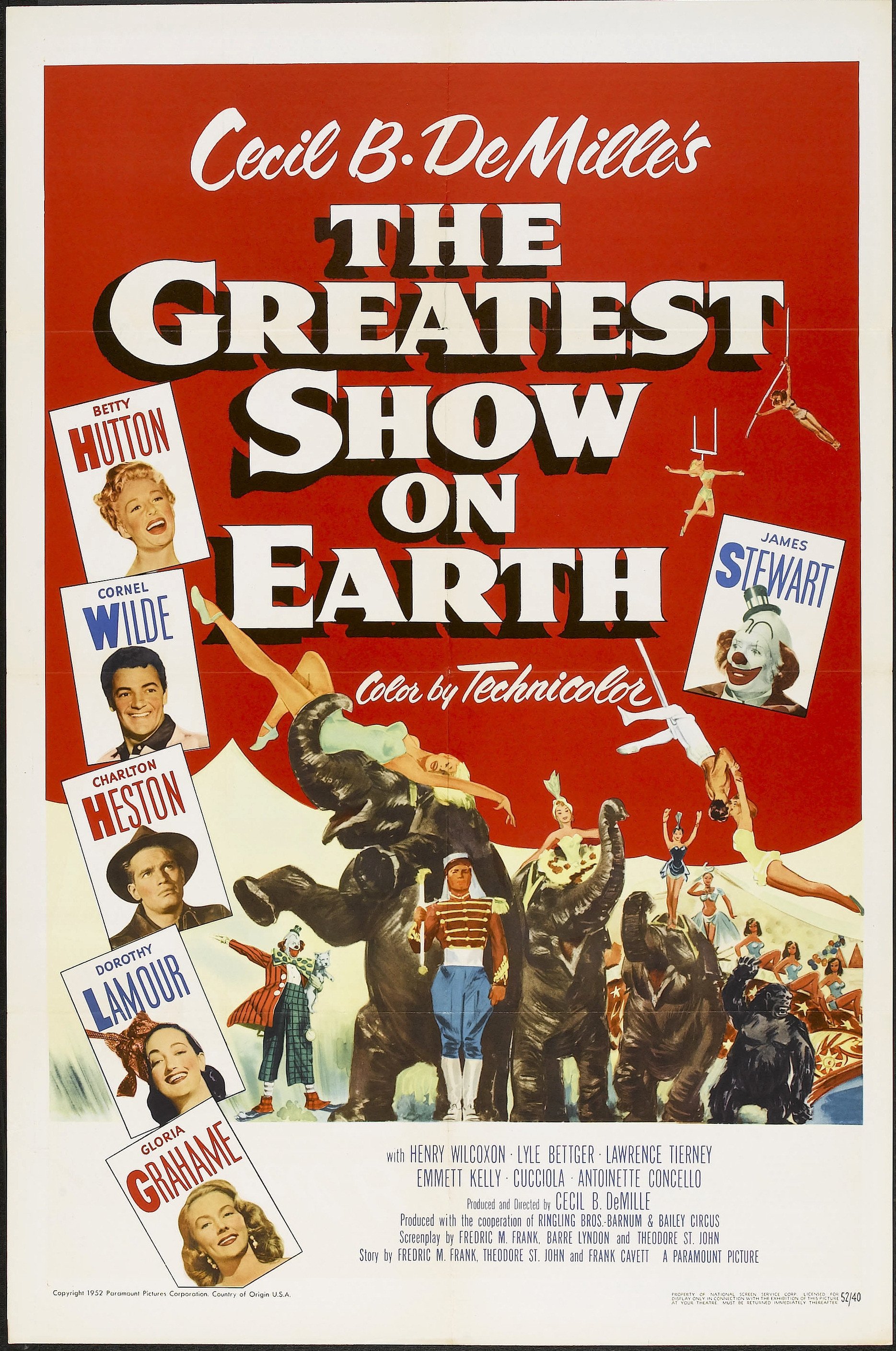
In the golden age of Hollywood spectacle, few films dared to dream as big as Cecil B. DeMille’s The Greatest Show on Earth. This 1952 circus epic didn’t just aim to entertain audiences—it sought to capture the very essence of American showmanship under the big top. With its ambitious scope, star-studded cast, and unprecedented access to the Ringling Bros. and Barnum & Bailey Circus, this film remains a fascinating time capsule of entertainment history.
A Spectacular Vision Under the Big Top
The Greatest Show on Earth emerged during Hollywood’s peak studio system era, when major productions could command massive budgets and studio resources. DeMille, already a legend for his biblical epics and historical dramas, turned his attention to the American circus—a subject that allowed him to combine his love of spectacle with intimate human drama.
The film’s production was nothing short of extraordinary. DeMille negotiated unprecedented access to the actual Ringling Bros. and Barnum & Bailey Circus, incorporating real performers, animals, and equipment into his narrative. This authentic foundation gives The Greatest Show on Earth a documentary-like quality that elevates it beyond typical Hollywood fiction.
The Star-Studded Cast Brings Magic to Life
The ensemble cast of The Greatest Show on Earth reads like a who’s who of 1950s Hollywood royalty:
• Betty Hutton as Holly, the ambitious trapeze artist with dreams of stardom • Cornel Wilde as Sebastian, the talented but arrogant aerialist • Charlton Heston as Brad Braden, the no-nonsense circus manager • Dorothy Lamour as Phyllis, the elephant trainer caught in romantic turmoil • Gloria Grahame as Angel, Sebastian’s former partner • James Stewart as Buttons the Clown, hiding a mysterious past behind his painted smile
Each performer brings distinct energy to their role, creating a tapestry of personalities that mirrors the diverse world of circus life. Hutton’s Holly embodies the American dream of small-town ambition meeting big-city opportunity, while Heston’s Brad represents the pragmatic leadership necessary to keep such a complex operation running smoothly.
Plot Overview: Dreams and Drama Under Canvas
The narrative of The Greatest Show on Earth weaves multiple storylines together, much like the three-ring circus it depicts. At its heart, the film follows Holly’s rise from center ring to the coveted position in the aerial ballet, while romantic tensions simmer between her, Sebastian, and Brad.
The central conflict revolves around the circus’s financial struggles and the constant pressure to deliver bigger, more spectacular performances. When Sebastian joins the troupe as a star performer, his presence threatens the delicate balance Brad has worked to maintain. Sebastian’s reckless pursuit of increasingly dangerous stunts creates tension that builds toward the film’s climactic disaster.
The Human Stories Behind the Spectacle
What sets The Greatest Show on Earth apart from other spectacle films is its attention to the human stories behind the razzle-dazzle. Stewart’s Buttons provides the film’s emotional anchor—a doctor hiding from the law after a mercy killing, finding redemption through his service to circus performers and animals.
The romantic subplot between Holly and Brad develops against the backdrop of circus life, where personal relationships must navigate the demands of constant travel and performance pressure. Their relationship reflects the broader theme of balancing personal desires with professional obligations that runs throughout the film.
Technical Mastery and Cinematic Innovation
The Greatest Show on Earth showcased cutting-edge filmmaking techniques that were revolutionary for 1952. DeMille and his cinematographers employed multiple cameras to capture the circus acts from various angles, creating a sense of immediacy and excitement that puts viewers right in the action.
The film’s use of Technicolor was particularly striking, bringing the vibrant costumes, colorful tents, and spectacular performances to vivid life. The color palette emphasizes the contrast between the mundane world outside and the magical realm within the circus, reinforcing the film’s themes about escapism and wonder.
Authentic Circus Integration
Perhaps the most impressive technical achievement of The Greatest Show on Earth was its seamless integration of Hollywood narrative with authentic circus performance. DeMille’s crew worked closely with Ringling Bros. performers to ensure that every act shown on screen maintained the genuine excitement and skill of actual circus performance.
The aerial sequences, in particular, required extensive coordination between stunt performers and actors. The film’s commitment to authenticity meant that many dangerous sequences were performed with minimal special effects, creating a sense of real peril that enhances the dramatic tension.
Themes of American Ambition and Entertainment
The Greatest Show on Earth operates on multiple thematic levels, examining the nature of entertainment, ambition, and the American dream. The circus serves as a metaphor for America itself—a place where diverse individuals can come together to create something larger than themselves.
The film explores the cost of ambition through Sebastian’s character, whose pursuit of ever-greater thrills ultimately leads to tragedy. This theme resonates with the broader cultural anxieties of the 1950s, when American prosperity came with new pressures and expectations.
The Business of Dreams
One particularly prescient aspect of The Greatest Show on Earth is its examination of entertainment as business. Brad’s constant worry about attendance figures and profit margins reflects the reality that even the most magical experiences require financial sustainability. This theme has only become more relevant in our modern entertainment landscape, where creative industries must balance artistic vision with commercial viability—a principle that applies whether you’re managing a circus or making informed decisions about entertainment investments.
Historical Context and Cultural Impact
The Greatest Show on Earth arrived at a pivotal moment in American entertainment history. The early 1950s marked the beginning of television’s rise, which would eventually challenge both circuses and movie theaters for audience attention. The film can be read as a nostalgic celebration of live entertainment in an increasingly mediated world.
The movie’s portrayal of circus life, while romanticized, captured genuine aspects of a uniquely American institution. The traveling circus represented freedom, adventure, and the possibility of reinvention—themes that resonated strongly with post-war audiences seeking new forms of excitement and escape.
Academy Recognition and Industry Impact
The Greatest Show on Earth achieved the ultimate Hollywood recognition by winning the Academy Award for Best Picture, competing against films like High Noon and The Quiet Man. This victory reflected the Academy’s appreciation for DeMille’s ambitious production and its celebration of American entertainment traditions.
The film’s success influenced subsequent spectacle films and established a template for movies that combine multiple storylines with spectacular set pieces. Its impact can be seen in later circus-themed films and in the broader development of event cinema that prioritizes visual spectacle alongside narrative drama.
Critical Reception and Legacy
Contemporary critics had mixed reactions to The Greatest Show on Earth. While many praised its spectacular visuals and ambitious scope, some felt that the multiple plotlines diluted the overall impact. Critics noted that the film sometimes felt more like a documentary about circus life than a cohesive dramatic narrative.
However, time has been kinder to The Greatest Show on Earth. Modern viewers appreciate its historical value as a record of authentic circus performance and its technical achievements in capturing live entertainment on film. The movie serves as an invaluable document of a uniquely American form of entertainment that has largely disappeared from the cultural landscape.
Influence on Modern Entertainment
The film’s approach to blending reality with fiction has influenced countless productions, from reality television to documentary filmmaking. The concept of using authentic settings and real performers within fictional narratives has become a standard technique in modern cinema, seen in films ranging from sports movies to musical biopics.
The Greatest Show on Earth also anticipated the modern entertainment industry’s fascination with behind-the-scenes content. Audiences today are increasingly interested in the mechanics of how entertainment is created, and DeMille’s film was ahead of its time in satisfying this curiosity.
The Spectacular Train Crash Sequence
No discussion of The Greatest Show on Earth would be complete without examining its famous train crash sequence. This climactic disaster serves multiple narrative functions while delivering one of cinema’s most memorable action sequences.
The crash represents the collision between human ambition and natural forces, embodying the film’s themes about the risks inherent in pursuing spectacular entertainment. DeMille and his team created this sequence using a combination of practical effects, miniatures, and real train cars, resulting in a visceral impact that still impresses modern audiences.
Technical Achievement and Narrative Purpose
The train crash sequence demonstrates how The Greatest Show on Earth uses spectacle to serve story rather than simply overwhelming it. The disaster forces characters to confront their priorities and relationships, stripping away the glamour of circus life to reveal essential human values.
This sequence also showcases the circus community’s solidarity in crisis, reinforcing the film’s themes about found family and mutual support. The way performers and crew members work together to rescue victims and save the show illustrates the deeper bonds that unite the circus family beyond their professional relationships.
Performances That Define an Era
The acting in The Greatest Show on Earth reflects the studio system’s approach to star vehicles, where established personalities were cast to embody particular character types. Each major performer brings their established screen persona to bear on their circus roles.
Betty Hutton’s energetic performance as Holly captures the boundless optimism and determination that characterized 1950s American culture. Her musical numbers and acrobatic sequences showcase the era’s emphasis on versatility in entertainment performers.
Charlton Heston’s Brad Braden established many of the character traits that would define his later heroic roles. His portrayal of steady leadership under pressure prefigures his iconic performances in epic films throughout the decade.
James Stewart’s Memorable Supporting Role
James Stewart’s performance as Buttons the Clown represents one of the film’s most poignant elements. His ability to convey deep emotion through minimal dialogue and behind clown makeup demonstrates the acting mastery that made him one of Hollywood’s most beloved stars.
Stewart’s scenes provide The Greatest Show on Earth with its most touching moments, particularly his interactions with sick children and his eventual revelation of his true identity. These sequences add emotional depth to what could have been merely a spectacle-driven narrative.
Cinematography and Visual Design
The visual design of The Greatest Show on Earth creates a world that feels both magical and authentic. The film’s production design team worked closely with circus professionals to ensure accuracy in everything from costume details to equipment placement.
The cinematography employs techniques that maximize the sense of scale and excitement. Wide shots capture the scope of circus operations, while close-ups focus on individual moments of triumph and tension. The camera work during performance sequences puts viewers in the position of audience members, creating an immersive experience that brings the circus directly to moviegoers.
Color as Storytelling Tool
The Greatest Show on Earth uses Technicolor not just for visual appeal but as a narrative device. The bright, saturated colors of circus costumes and decorations contrast with the more muted tones of the outside world, visually reinforcing the separation between circus life and ordinary existence.
During dramatic sequences, the color palette shifts to reflect emotional tone. The warm yellows and reds of performance scenes give way to cooler blues and grays during moments of conflict or tragedy, creating visual harmony between story and mood.
Musical Score and Sound Design
The musical score of The Greatest Show on Earth enhances both the spectacle and intimacy of circus life. The soundtrack incorporates traditional circus music while adding Hollywood orchestration that elevates familiar melodies to epic proportions.
Sound design plays a crucial role in creating the authentic atmosphere of circus performance. The film captures the sounds of audiences, animals, and equipment that make circus environments feel alive and dynamic. These audio elements contribute significantly to the film’s documentary-like authenticity.
Legacy and Modern Relevance
The Greatest Show on Earth remains relevant today as both entertainment and historical document. The film captures a form of live entertainment that has largely disappeared from American culture, making it an invaluable record of circus traditions and techniques.
The movie’s themes about the entertainment industry’s evolution have proven prophetic. Questions about balancing artistic integrity with commercial success, the relationship between performers and audiences, and the role of spectacle in modern media continue to resonate in our digital age.
For film enthusiasts and historians, The Greatest Show on Earth offers insights into 1950s Hollywood production techniques and cultural values. The film demonstrates how major studios approached prestige projects and how filmmakers integrated real-world elements into fictional narratives.
The Academy of Motion Picture Arts and Sciences continues to recognize The Greatest Show on Earth as a significant achievement in American cinema, maintaining its status as an important cultural artifact worthy of preservation and study.
Final Verdict: A Timeless Spectacle
The Greatest Show on Earth succeeds as both entertainment and cultural document. While its multiple plotlines occasionally feel scattered, the film’s commitment to authentic spectacle and its celebration of American entertainment traditions create a viewing experience that remains engaging and informative.
DeMille’s final circus epic captures a moment in entertainment history that can never be replicated. The combination of Hollywood star power with genuine circus artistry produces a unique hybrid that showcases the best of both worlds.
For modern audiences, The Greatest Show on Earth offers a window into a vanished form of entertainment while telling timeless stories about ambition, love, and the pursuit of dreams. The film’s technical achievements and historical value ensure its continued relevance for future generations of movie lovers and cultural historians.
The Greatest Show on Earth ultimately stands as a testament to the power of spectacle when combined with genuine human emotion. In an age of digital effects and virtual entertainment, the film’s emphasis on real performers doing actual stunts feels both nostalgic and refreshing. It reminds us that the greatest shows are those that touch our hearts while dazzling our eyes—a lesson that remains as relevant today as it was in 1952.
Leave a Reply