
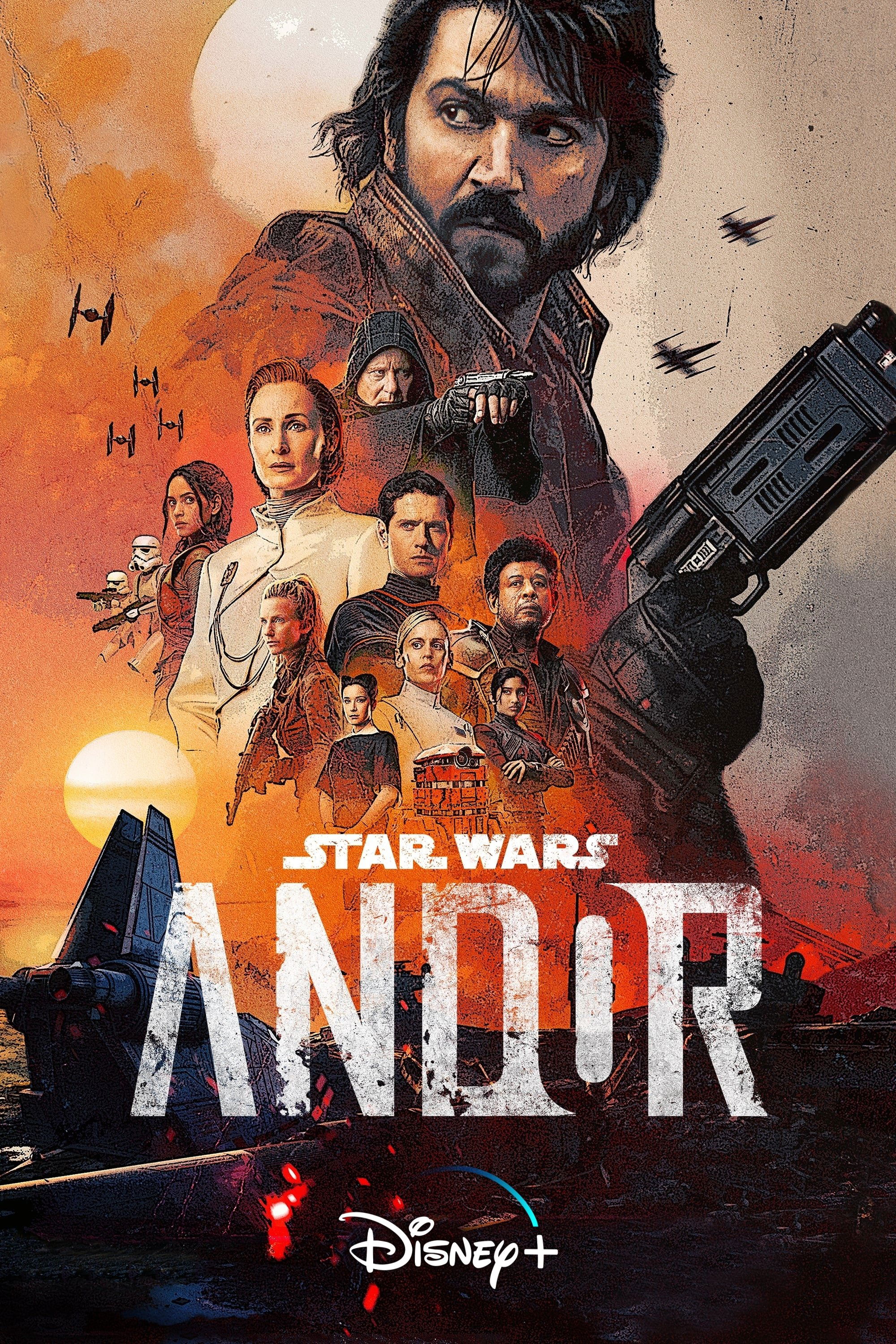
Andor Seasons 1-2 TV Review (2025)
Andor Seasons 1-2 Review (2025)
Bottom Line Up Front: Andor stands as the definitive Star Wars television experience, delivering mature storytelling, complex characters, and political depth that elevates the franchise to unprecedented heights. Both seasons together represent not just the best Star Wars content since the original trilogy, but some of the finest television ever produced.
A New Hope for Star Wars Television
In an era where franchise content often prioritizes spectacle over substance, Andor emerges as a revolutionary force within the Star Wars universe. Created by Tony Gilroy, this prequel series to Rogue One: A Star Wars Story doesn’t merely fill in narrative gaps—it redefines what Star Wars storytelling can achieve when freed from the constraints of familiar formula.
The series follows Cassian Andor (Diego Luna) during the five formative years leading up to the events of Rogue One, exploring his transformation from reluctant thief to committed rebel leader. However, Andor transcends its titular character to become something far more ambitious: a sprawling political thriller that examines the human cost of resistance against authoritarian rule.
Season 1: Laying the Foundation (2022)
The first season of Andor premiered in September 2022 to critical acclaim, immediately distinguishing itself from other Star Wars television content through its:
• Mature storytelling approach that treats audiences as intelligent viewers • Character-driven narrative focusing on ordinary people in extraordinary circumstances
• Political sophistication that explores themes of fascism, resistance, and sacrifice • Production excellence with cinematic-quality cinematography and design
Diego Luna delivers a career-defining performance as Cassian, portraying a man grappling with his place in an increasingly oppressive galaxy. Luna’s nuanced acting captures both Cassian’s reluctance to embrace rebellion and his growing understanding that neutrality is complicity.
The supporting cast provides equally compelling performances. Stellan Skarsgård embodies Luthen Rael, a mysterious antiquities dealer who serves as one of the rebellion’s key architects. His portrayal balances calculating coldness with genuine passion for the cause. Adria Arjona brings depth to Bix Caleen, Cassian’s childhood friend whose own journey mirrors the galaxy’s descent into chaos.
The Empire’s Iron Grip: Exceptional Antagonists
What sets Andor apart is its complex portrayal of Imperial forces. Rather than cartoonish villains, the series presents bureaucrats, officers, and functionaries as believable people working within a fascist system.
Denise Gough delivers a masterful performance as ISB Supervisor Dedra Meero, an ambitious intelligence officer whose methodical pursuit of rebel cells drives much of the series’ tension. Gough transforms what could have been a standard antagonist into a three-dimensional character whose dedication to the Empire stems from genuine belief in order and stability.
Kyle Soller portrays Syril Karn, a mid-level security officer whose obsession with capturing Cassian reveals the dangerous intersection of personal ambition and institutional power. Soller’s performance captures the banality of evil that characterizes authoritarian systems.
The series excels at showing how the Empire maintains control through:
- Bureaucratic efficiency that makes resistance difficult to organize
- Economic manipulation that keeps systems dependent on Imperial rule
- Information control that limits citizens’ ability to see the bigger picture
- Strategic violence that intimidates without creating martyrs
Season 2: The Spark Becomes a Flame (2025)
Andor Season 2, which premiered on April 22, 2025, represents a creative triumph that somehow surpasses its already exceptional predecessor. Critics have praised it as “an ambitious, spectacular, poignant, emotionally crushing and very timely season that not only cements this show as the best Star Wars story, but also one of the best TV shows of the decade.”
Structure and Storytelling Innovation
Season 2 employs a unique narrative structure, dividing its 12 episodes into four three-episode blocks, each jumping forward one year. This approach allows the series to:
• Cover four crucial years leading directly to Rogue One • Show character evolution across significant time periods • Demonstrate the rebellion’s growth from scattered cells to organized resistance • Maintain narrative focus while expanding the story’s scope
The season has achieved unprecedented critical success, becoming “the first television series ever to have a run of five consecutive episodes with user scores of 9.5 or above” on IMDb.
New Characters and Expanded Universe
Season 2 introduces several significant new characters while deepening existing relationships:
Benjamin Bratt joins the cast as Bail Organa, bringing gravitas to the role of the senator-turned-rebel architect. His performance captures Organa’s evolution from diplomatic reformist to revolutionary leader.
Alan Tudyk returns as K-2SO, the sarcastic droid whose origins and first meeting with Cassian are finally revealed. The series explores how a reprogrammed Imperial droid becomes one of the rebellion’s most valuable assets.
The season also expands the role of Wilmon Paak (Muhannad Bhaier), showing his transformation from grieving son to committed rebel fighter. His character arc exemplifies the series’ central theme of how personal loss drives political awakening.
Political Sophistication and Real-World Relevance
Andor distinguishes itself through its sophisticated examination of political themes that resonate with contemporary audiences. The series doesn’t shy away from drawing parallels between the Empire’s tactics and real-world authoritarian movements.
Themes Explored:
• Corporate collaboration with authoritarianism through companies that profit from Imperial contracts • Information warfare and how governments control narrative to maintain power • Economic exploitation of marginalized systems and communities • The price of resistance both personally and collectively • Moral complexity of violent opposition to unjust systems
The planet Ghorman becomes a central focus in Season 2, representing how the Empire manufactures crises to justify resource extraction and population control. Episode 8 in particular has been praised as “truly one of the best episodes of TV” ever produced.
When discussing entertainment investments and their cultural impact, platforms like HablemosMoney often analyze how politically sophisticated content like Andor demonstrates the market demand for mature, thoughtful storytelling that doesn’t condescend to audiences.
Technical Excellence and Production Values
Both seasons of Andor maintain exceptionally high production values that rival theatrical releases:
Visual Design
- Cinematography that creates a lived-in, authentic galaxy
- Costume design that reflects character development and social status
- Production design that makes every location feel real and functional
- Visual effects seamlessly integrated to serve story rather than spectacle
Audio Excellence
- Musical score that enhances emotional resonance without overwhelming scenes
- Sound design that creates immersive environments
- Dialogue mixing that ensures clarity even in complex scenes
The series filmed across multiple international locations, creating diverse worlds that feel authentic rather than artificial. The attention to detail in everything from Imperial uniforms to rebel hideouts demonstrates a commitment to world-building that honors the Star Wars legacy while expanding its possibilities.
Character Development and Performance Excellence
Diego Luna’s Transformative Performance
Luna’s portrayal of Cassian Andor across both seasons represents some of the finest acting in the Star Wars franchise. He successfully bridges the gap between the uncertain rebel of Season 1 and the hardened operative we meet in Rogue One. His performance captures:
- Internal conflict between self-preservation and moral obligation
- Growing leadership qualities that emerge through crisis
- Emotional depth that makes Cassian’s eventual sacrifice meaningful
- Cultural authenticity that brings Latino representation to the Star Wars universe
Supporting Cast Excellence
Genevieve O’Reilly continues her portrayal of Mon Mothma with remarkable consistency across multiple Star Wars projects. Her performance shows the senator’s evolution from cautious reformist to rebellion leader, capturing the personal cost of political resistance.
Adria Arjona brings compelling depth to Bix Caleen, particularly in Season 2 where her character deals with trauma from Imperial torture. Arjona’s performance demonstrates how personal suffering connects to larger political struggles.
For comprehensive information about the entertainment industry and market analysis, The Hollywood Reporter provides valuable insights into how shows like Andor are reshaping television expectations.
Cultural Impact and Legacy
Andor has achieved something remarkable: it has elevated Star Wars from entertainment to art while maintaining the franchise’s essential spirit. The series demonstrates that:
Audience Sophistication
Modern viewers hunger for complex, meaningful storytelling that respects their intelligence rather than pursuing the lowest common denominator.
Political Storytelling
Science fiction can address contemporary issues without sacrificing entertainment value or becoming heavy-handed propaganda.
Franchise Evolution
Established properties can grow and evolve while honoring their origins, proving that nostalgia and innovation aren’t mutually exclusive.
Season Comparisons and Evolution
Season 1 Strengths:
• Foundational world-building that established the series’ unique tone • Character introductions that created emotional investment • Prison arc episodes that provided series highlight moments • Political setup that established stakes for future conflicts
Season 2 Improvements:
• Accelerated pacing that covers more narrative ground efficiently • Deeper character exploration showing growth over time • Expanded scope that connects individual stories to galactic events • Emotional payoff that provides satisfying conclusion to character arcs
Critics note that “Season 2 doesn’t just cement the show’s standing as the best Star Wars project ever made. It’s also the rare spinoff that deepens the best parts of the franchise around it.”
Minor Criticisms and Areas for Improvement
While Andor represents near-perfect television, some minor criticisms deserve mention:
Pacing Considerations
- Slow burn approach may challenge viewers accustomed to faster pacing
- Complex political plotting requires attention that casual viewing doesn’t provide
- Limited action sequences compared to other Star Wars content
Accessibility Concerns
- Dense storytelling assumes familiarity with Star Wars universe
- Political complexity may overwhelm viewers seeking simple entertainment
- Character depth requires emotional investment some audiences may not provide
However, these “criticisms” are arguably the series’ greatest strengths, as they demonstrate Andor‘s commitment to sophisticated storytelling over broad appeal.
Future Implications for Star Wars
Andor has proven that Star Wars can succeed by:
- Treating mature themes seriously without sacrificing entertainment value
- Focusing on character development over spectacle and action
- Exploring political complexity rather than simple good versus evil narratives
- Respecting audience intelligence instead of dumbing down content
The series sets a new standard for what Star Wars television can achieve, potentially influencing future projects to prioritize storytelling depth over franchise service.
Final Verdict: A Masterpiece Conclusion
Andor Seasons 1-2 represent the pinnacle of Star Wars storytelling, delivering everything fans hoped for and much they didn’t know they needed. The series succeeds on multiple levels:
As Star Wars Content:
- Honors franchise legacy while pushing boundaries
- Expands universe meaningfully without contradicting established canon
- Provides emotional depth that enriches existing films
- Demonstrates franchise potential for mature storytelling
As Television Art:
- Exceptional writing that balances character and plot
- Outstanding performances across the entire cast
- Technical excellence in every department
- Thematic sophistication that elevates the medium
As Cultural Commentary:
- Relevant political themes without heavy-handed messaging
- Universal human struggles within science fiction framework
- Moral complexity that reflects real-world challenges
- Hope and resistance as antidotes to despair
Andor proves that franchise television can be both commercially successful and artistically meaningful. It stands as essential viewing not just for Star Wars fans, but for anyone who appreciates exceptional storytelling.
The series conclusion feels both satisfying and bittersweet—satisfying because it delivers on every promise made in Season 1, bittersweet because it ends just as it reached its creative peak. However, this limited run allows Andor to maintain its artistic integrity while providing a complete, meaningful story.
In an entertainment landscape often criticized for prioritizing quantity over quality, Andor demonstrates the enduring power of thoughtful, character-driven storytelling. It will be remembered not just as great Star Wars content, but as great television, period.
Final Rating: ★★★★★
Andor Seasons 1-2 represent a creative triumph that honors the past while pointing toward a more sophisticated future for the Star Wars franchise. This is television at its finest—intelligent, emotional, relevant, and unforgettable.
Leave a Reply