
Star Trek (1969) Complete TV Review
Star Trek (1969) Complete TV Review
“To boldly go where no man has gone before” – these immortal words launched television into a new frontier when Star Trek premiered on NBC in 1966, originally concluding its legendary three-season run in 1969. Created by visionary Gene Roddenberry, this groundbreaking science fiction series didn’t just entertain audiences; it fundamentally transformed the landscape of television and popular culture. What began as a modest space adventure show has evolved into one of the most influential and enduring franchises in entertainment history.
Set in the 23rd century, Star Trek follows the voyages of the starship USS Enterprise under the command of Captain James T. Kirk. The series presents an optimistic vision of humanity’s future, where diverse crews work together to explore strange new worlds and seek out new life and civilizations. For those interested in exploring more classic television reviews and analysis, HablemosMoney offers comprehensive coverage of film and TV content that shaped our cultural landscape.
Production Background and Creation
Gene Roddenberry conceived Star Trek as “Wagon Train to the Stars,” envisioning a series that would use the science fiction setting to explore contemporary social issues. The show faced significant hurdles from its inception, with NBC initially rejecting the first pilot episode, “The Cage,” featuring Jeffrey Hunter as Captain Pike. In an unprecedented move, the network commissioned a second pilot, “Where No Man Has Gone Before,” which introduced most of the iconic characters we know today.
Norway Productions and Desilu Productions produced the series from September 1966 to December 1967. Paramount Television produced the show from January 1968 to June 1969. Star Trek aired on NBC from September 8, 1966, to June 3, 1969. The series was first broadcast in Canada on CTV network on September 6, 1966, two days before its U.S. premiere.
The production faced constant budget constraints and network interference throughout its run. After Star Trek’s second season, word got around that NBC was prepared to cancel the show due to low ratings. Led by fans Bjo and John Trimble, Trek viewers inundated NBC with letters protesting the show’s demise and pleading with the network to renew the series for another year. This unprecedented fan campaign demonstrated the passionate devotion that Star Trek inspired, setting a precedent for fan activism in television history.
Main Cast and Characters
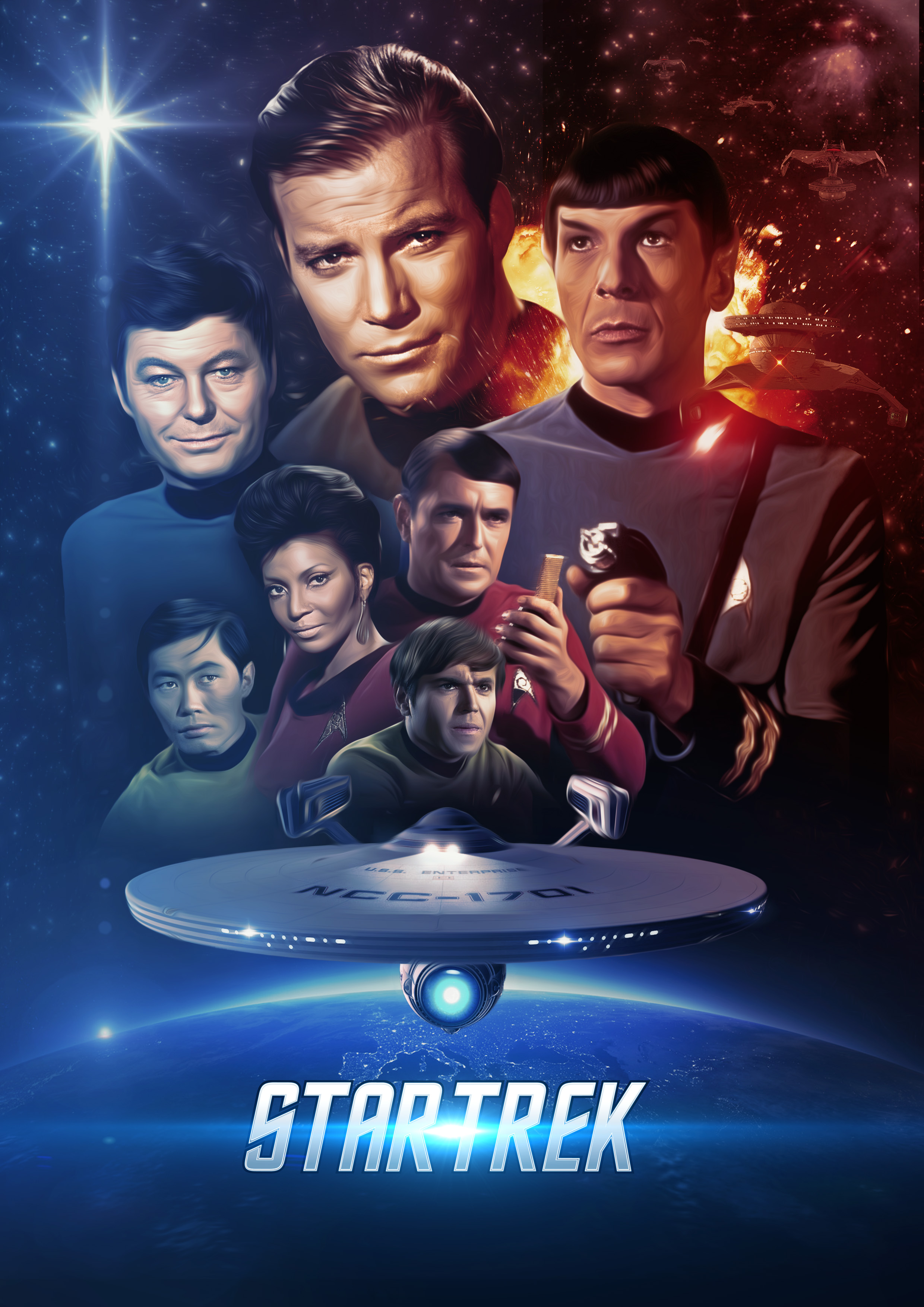
The heart of Star Trek lies in its exceptional ensemble cast, who brought depth and humanity to their roles that resonated far beyond the show’s original run.
William Shatner as Captain James T. Kirk
William Shatner as James T. Kirk, commanding officer of the USS Enterprise. Shatner’s portrayal of Kirk became the gold standard for starship captains. Kirk embodied the bold, decisive leadership style that defined Starfleet commanders, balancing diplomatic finesse with tactical brilliance. His character served as the emotional center of the series, often forced to make impossible decisions that tested his moral compass and leadership abilities.
Leonard Nimoy as Mr. Spock
Leonard Nimoy as Spock, first officer and science officer. Perhaps no character in science fiction history has achieved the cultural impact of Mr. Spock. Nimoy’s portrayal of the half-human, half-Vulcan science officer created an iconic figure who struggled with the duality of his nature. Spock’s logical approach to problem-solving, combined with his suppressed emotions, provided both philosophical depth and dramatic tension throughout the series.
DeForest Kelley as Dr. Leonard “Bones” McCoy
DeForest Kelley as Leonard McCoy, chief medical officer. Dr. McCoy served as the emotional conscience of the Enterprise crew, often clashing with Spock’s logical approach while providing medical expertise and humanitarian perspective. Kelley’s performance brought warmth and humanity to the role, making McCoy the heart of the series’ central triumvirate.
Supporting Cast Excellence
The supporting cast members each brought unique qualities that enriched the Star Trek universe:
• Nichelle Nichols as Lieutenant Uhura – Nichelle Nichols as Nyota Uhura, communications officer broke ground as one of television’s first prominent African-American characters in a non-stereotypical role
• James Doohan as Montgomery “Scotty” Scott – James Doohan as Montgomery Scott, chief engineer brought technical expertise and Scottish charm to the engineering deck
• George Takei as Hikaru Sulu – Walter Koenig as Pavel Chekov, navigator and security/tactical officer represented Asian heritage in a positive, non-stereotypical manner
• Walter Koenig as Pavel Chekov – Added in the second season, Chekov brought youthful energy and represented the show’s international perspective
• Majel Barrett as Nurse Christine Chapel – Majel Barrett as Nurse Christine Chapel, medical officer. Barrett also voiced the ship’s computer
• Grace Lee Whitney as Janice Rand – Grace Lee Whitney as Janice Rand, Captain’s yeoman appeared in the first season as Kirk’s assistant
Season 1 (1966-1967): Foundation of Greatness
The first season of the American science-fiction television series Star Trek, originally created by Gene Roddenberry, premiered on NBC on September 8, 1966, and concluded on April 13, 1967… It consisted of 29 episodes, which is the highest number of episodes in a season for the original series of Star Trek.
The inaugural season established the series’ core mythology and introduced audiences to the fascinating world of the 23rd century. Season 1 featured several landmark episodes that remain classics of science fiction television:
Essential Season 1 Episodes:
- “The Man Trap” (September 8, 1966) – The series premiere introduced the Enterprise crew and established the show’s format
- “Where No Man Has Gone Before” (September 22, 1966) – The second pilot that convinced NBC to greenlight the series
- “The Naked Time” (September 29, 1966) – A psychological thriller where the crew loses their inhibitions
- “Balance of Terror” (December 15, 1966) – Introduced the Romulans and showcased tactical space warfare
- “The Corbomite Maneuver” (November 10, 1966) – Demonstrated Kirk’s tactical brilliance and diplomatic skills
- “Arena” (January 19, 1967) – Kirk battles a Gorn captain in single combat
- “Space Seed” (February 16, 1967) – Introduced Khan Noonien Singh, later featured in Star Trek II: The Wrath of Khan
- “The City on the Edge of Forever” (April 6, 1967) – Widely considered the series’ finest episode, exploring time travel and sacrifice
Season 1 Themes and Impact
The first season tackled complex themes including:
• Cold War allegories through conflicts with alien civilizations • Social justice through diverse casting and progressive storylines
• Philosophy and ethics in challenging moral dilemmas • Scientific exploration balanced with human drama • Diplomatic solutions over military force
On review aggregator Rotten Tomatoes, Season 1 received an approval rating of 92% based on 24 reviews, with an average rating of 9/10. The critical consensus reads, “An optimistic ode to humanity, Star Trek may look dated, but its gadgetry and solid storytelling solidify its place as one of pop culture’s most enduring franchises.”
Season 2 (1967-1968): Creative Peak
The second season of Star Trek is widely regarded as the series’ creative and artistic peak. Building upon the solid foundation of Season 1, the writers and producers refined the show’s formula while introducing new characters and exploring more complex storylines.
Key Season 2 Additions:
• Walter Koenig joined as Ensign Pavel Chekov, expanding the bridge crew and adding international representation • Enhanced special effects and production values • Deeper character development for the main cast • More sophisticated storytelling techniques
Season 2 Standout Episodes:
- “Amok Time” (September 15, 1967) – Explored Vulcan culture and Spock’s private life
- “Mirror, Mirror” (October 6, 1967) – The legendary alternate universe episode featuring the evil Empire
- “The Doomsday Machine” (October 20, 1967) – A tense space thriller with spectacular special effects
- “Journey to Babel” (November 17, 1967) – Introduced Spock’s parents and featured complex diplomatic intrigue
- “The Trouble with Tribbles” (December 29, 1967) – The beloved comedy episode that became a fan favorite
- “A Piece of the Action” (January 12, 1968) – A lighthearted adventure on a gangster planet
- “The Ultimate Computer” (March 8, 1968) – Explored themes of automation and human worth
- “Assignment: Earth” (March 29, 1968) – A backdoor pilot for a potential spin-off series
Season 2 Excellence
Season 2 received an approval rating of 100% based on 6 reviews, with an average rating of 7.33/10. This season demonstrated the series’ ability to balance action, drama, comedy, and philosophical content. The writing reached new heights of sophistication, while the cast developed an impressive chemistry that made their relationships feel authentic and lived-in.
The season showcased Star Trek at its finest:
• Character-driven narratives that explored the crew’s personal relationships • Innovative science fiction concepts that influenced future media • Social commentary addressing contemporary issues through futuristic allegory • Technical achievements in special effects and production design
Season 3 (1968-1969): Challenges and Conclusion
The third and final season of Star Trek faced significant challenges that ultimately led to the series’ cancellation. Despite these obstacles, Season 3 contained several memorable episodes and provided closure to the original five-year mission.
Production Difficulties
After Star Trek’s second season, word got around that NBC was prepared to cancel the show due to low ratings… The network later changed the schedule so that Trek would air in the so-called “death slot”—Friday nights at 10:00 p.m. In addition to the “mismanaged” schedule, the show’s budget was “seriously slashed”
The production challenges included:
• Reduced budget affecting special effects and guest star quality • Difficult time slot that hurt viewership • Executive interference limiting creative freedom • Cast and crew fatigue after three demanding seasons
Notable Season 3 Episodes:
- “Spock’s Brain” (September 20, 1968) – The controversial season premiere
- “The Enterprise Incident” (September 27, 1968) – Featured Romulan cloaking technology
- “The Paradise Syndrome” (October 4, 1968) – Kirk loses his memory on a primitive planet
- “The Tholian Web” (November 9, 1968) – Kirk becomes trapped between dimensions
- “Plato’s Stepchildren” (November 22, 1968) – Featured television’s first interracial kiss
- “Let That Be Your Last Battlefield” (January 10, 1969) – A powerful allegory about racial prejudice
- “All Our Yesterdays” (March 14, 1969) – A time travel story set in an alien planet’s past
- “Turnabout Intruder” (June 3, 1969) – The final episode of the original series
Season 3 Assessment
Season 3 received an approval rating of 50% based on 10 reviews, with an average rating of 5.5/10. The critical consensus reads, “Budget cuts leave the stars of Star Trek stranded among shoddy set pieces and clunky writing – though even at its worst fans may still enjoy its campy delights.”
While Season 3 faced production challenges, it still delivered several strong episodes and important moments in Star Trek history. The season demonstrated the series’ resilience and the cast’s commitment to maintaining quality despite difficult circumstances.
Technical Achievements and Innovation
Star Trek pushed the boundaries of television production in numerous ways that influenced the entire industry:
Special Effects Revolution
• Model photography created believable spaceship sequences • Transporter effects became iconic science fiction imagery
• Phaser and photon torpedo effects established new standards • Alien makeup and prosthetics brought diverse alien races to life
Set Design and Props
• Bridge design became the template for future starship command centers • Tricorder and communicator props predicted real-world mobile technology • Costume design balanced functionality with futuristic aesthetics • Color coordination maximized the impact of color television broadcasts
Sound Design
• Electronic music and sound effects created an otherworldly atmosphere • Distinctive sound signatures for transporters, phasers, and ship systems • Musical themes that became instantly recognizable cultural touchstones
Cultural Impact and Legacy
Star Trek transcended its status as a television series to become a cultural phenomenon that influenced society in profound ways:
Social Progress
• Diverse casting broke television barriers and promoted inclusion • Progressive storylines addressed racism, war, and social justice • Female characters in positions of authority and responsibility • International cooperation modeled through the United Federation of Planets
Technological Inspiration
The series predicted and inspired numerous real-world innovations:
- Mobile phones (inspired by communicators)
- Tablet computers (inspired by PADDs)
- Flat-screen displays (bridge viewscreens)
- Wireless earpieces (Uhura’s communications equipment)
- Voice interface technology (ship’s computer)
Educational Influence
Star Trek encouraged interest in science, technology, engineering, and mathematics (STEM) fields:
• NASA recruitment – Nichelle Nichols helped recruit astronauts for NASA • Scientific accuracy in storylines promoted learning • Space exploration advocacy influenced public support for space programs • International cooperation demonstrated possibilities for peaceful collaboration
Performances and Character Development
The cast of Star Trek delivered performances that defined their characters for generations:
The Kirk-Spock-McCoy Dynamic
The central relationship between Kirk, Spock, and McCoy created one of television’s most compelling character triangles. Their interactions provided both dramatic tension and philosophical depth, with each character representing different aspects of human nature:
• Kirk – Emotion and intuition balanced with command responsibility • Spock – Logic and reason tempered by suppressed emotions
• McCoy – Compassion and humanity serving as moral compass
Supporting Character Growth
The supporting cast members developed their characters beyond their initial functions:
• Scotty evolved from ship’s engineer to miracle worker and problem solver • Uhura demonstrated competence and professionalism in her groundbreaking role • Sulu showed versatility and reliability across multiple ship functions • Chekov brought youthful enthusiasm and international perspective
Writing and Storytelling Excellence
Star Trek attracted talented writers who created some of television’s finest science fiction scripts:
Notable Writers and Episodes
• Gene L. Coon – Contributed to series mythology and character development • D.C. Fontana – Brought depth to character relationships and alien cultures • Harlan Ellison – Wrote “The City on the Edge of Forever” • Theodore Sturgeon – Authored “Shore Leave” and “Amok Time”
Storytelling Innovations
The series pioneered several narrative techniques that became science fiction standards:
- Parallel development – Stories that reflected contemporary issues through futuristic settings
- Character-driven plots – Personal conflicts that drove larger narratives
- Moral complexity – Situations without clear-cut heroes and villains
- Scientific speculation – Hard science fiction concepts accessible to general audiences
Music and Audio Design
The musical elements of Star Trek created an integral part of the viewing experience:
Theme Music
Alexander Courage’s iconic theme music became one of television’s most recognizable compositions. The soaring orchestral arrangement perfectly captured the series’ spirit of exploration and adventure.
Episode Scoring
The musical scores enhanced dramatic moments and created atmosphere:
• Suspenseful sequences built tension through electronic and orchestral elements • Alien encounters featured otherworldly musical accompaniment • Emotional scenes used music to deepen character connections • Action sequences employed driving rhythms to enhance excitement
Syndication Success and Continued Relevance
Through broadcast syndication it became an international success in the 1970s, achieving cult classic status and a developing influence on popular culture. Star Trek eventually spawned a media franchise consisting of 11 television series, 13 feature films, and numerous books, games, and toys, and is now widely considered one of the most popular and influential television series of all time.
The Syndication Phenomenon
Following its network cancellation, Star Trek found new life in syndication where it:
• Built a massive fanbase through repeated viewings • Attracted new audiences who missed the original broadcasts • Developed cult status that surpassed its original network run • Influenced a generation of future filmmakers and storytellers
Franchise Expansion
The success of the original series led to an unprecedented media franchise:
- Feature films beginning with Star Trek: The Motion Picture (1979)
- Television spinoffs including The Next Generation, Deep Space Nine, and Voyager
- Animated series that continued the original timeline
- Modern reboots that reimagined the classic characters for new audiences
Critical Assessment and Rankings
In 2016, in a listing that included each Star Trek film and TV series together, this series was ranked first by the L.A. Times, ahead of the 1982 film Star Trek II: The Wrath of Khan and Star Trek: Deep Space Nine, in third place.
Contemporary Critical Reception
The series received mixed reviews during its original run, with critics recognizing its ambition while noting budget limitations and occasional uneven execution. However, the show’s reputation has steadily grown over the decades.
Modern Perspective
Contemporary critics and scholars recognize Star Trek as:
• Groundbreaking television that pushed creative and social boundaries • Influential science fiction that predicted technological developments • Progressive entertainment that promoted diversity and inclusion • Quality storytelling that balanced entertainment with meaningful content
Technical Legacy and Home Video Evolution
The preservation and presentation of Star Trek episodes has evolved dramatically since the series’ original broadcast:
Remastering and Enhancement
In 2006, CBS Paramount Domestic Television (now CBS Television Distribution) announced that each Original Series episode would be re-syndicated in high definition after undergoing digital remastering, including both new and enhanced visual effects.
Home Video Releases
The series has been released in multiple formats:
- VHS releases beginning in the 1980s
- Laserdisc collections for enhanced video quality
- DVD box sets with extensive bonus features
- Blu-ray editions featuring remastered video and audio
- Streaming platforms making episodes easily accessible worldwide
International Impact and Global Reach
Star Trek transcended American television to become a global cultural phenomenon:
International Broadcasting
• United Kingdom – In the United Kingdom the series was not broadcast until July 12, 1969, coinciding with the Apollo 11 mission to land the first humans on the Moon • Canada – First international broadcaster, airing episodes before the U.S. premiere • Worldwide syndication brought the series to audiences across all continents
Cultural Translation
The series’ themes of exploration, cooperation, and progress resonated across cultural boundaries:
• Universal messages about peace and understanding • Scientific optimism that appealed to international audiences
• Diverse representation that reflected global perspectives • Philosophical content that transcended cultural differences
Educational and Scientific Influence
Star Trek has had a lasting impact on education and scientific advancement:
STEM Education
The series inspired countless individuals to pursue careers in science and technology:
• NASA partnerships including Nichelle Nichols’ recruitment efforts • Educational outreach through conventions and special programs • Technology predictions that motivated real-world innovation • Scientific consultation that brought credibility to fictional concepts
Academic Study
Star Trek has become a subject of serious academic research:
• Cultural studies examining the series’ social impact • Science fiction scholarship analyzing narrative techniques • Media studies investigating fan culture and fandom • Philosophy courses using episodes to explore ethical questions
Fan Culture and Convention Legacy
Star Trek pioneered modern fan culture and convention activities:
Fan Community Development
• Organized fan clubs created lasting communities • Fanzines and publications provided outlets for fan creativity • Letter-writing campaigns demonstrated fan power and influence • Costume and role-playing established convention traditions
Convention Culture
Star Trek conventions became the model for modern pop culture events:
• Celebrity appearances by cast and crew members • Merchandise sales creating a thriving collectibles market • Fan presentations allowing audience participation and creativity • Cultural celebration of shared interests and values
Conclusion: A Timeless Television Masterpiece
More than five decades after its premiere, Star Trek remains a testament to the power of visionary storytelling and progressive ideals. Gene Roddenberry’s creation transcended the limitations of 1960s television to deliver a series that continues to inspire and entertain new generations of viewers.
The series succeeds on multiple levels:
• Entertainment value through compelling characters and exciting adventures • Social commentary that addressed important issues with intelligence and sensitivity
• Technological vision that predicted and influenced real-world innovations • Cultural impact that broke barriers and promoted inclusion • Artistic achievement that elevated science fiction television to new heights
The influence of Star Trek extends far beyond television, shaping our collective vision of the future and demonstrating the potential for humanity to overcome its differences in pursuit of knowledge and understanding. The series proved that science fiction could be both entertaining and meaningful, paving the way for generations of creators to explore complex themes through speculative storytelling.
For anyone interested in understanding the foundations of modern science fiction television, Star Trek remains essential viewing. Its combination of thoughtful writing, strong performances, and progressive values created a blueprint that continues to influence entertainment and culture today. Whether viewed as historical artifact or contemporary entertainment, the original Star Trek series stands as one of television’s greatest achievements – a bold journey that truly went where no one had gone before.
The legacy of Star Trek proves that great television transcends its time period to become something larger than entertainment – it becomes a shared cultural experience that defines our hopes and dreams for the future. In an era of division and uncertainty, the optimistic vision of Star Trek remains as relevant and inspiring as ever, reminding us that diversity is strength, cooperation is possible, and the future can be bright if we choose to make it so.
Rating: ★★★★★ (5/5 stars)
Star Trek (1966-1969) stands as a masterpiece of television science fiction that changed the medium forever. Despite budget limitations and network interference, the series delivered three seasons of memorable characters, innovative storytelling, and progressive values that continue to resonate with audiences worldwide. Essential viewing for any serious student of television history or science fiction entertainment.
Leave a Reply