
Drive (2011) Movie Review
Drive (2011) Movie Review
Bottom Line Up Front: Nicolas Winding Refn’s Drive is a masterclass in atmospheric filmmaking that transforms a simple crime story into a neon-soaked meditation on violence, romance, and redemption. While it may frustrate viewers expecting a traditional action thriller, those who embrace its hypnotic pacing and artistic sensibilities will discover one of the most stylistically influential films of the 2010s.
The Art of Slow-Burn Cinema
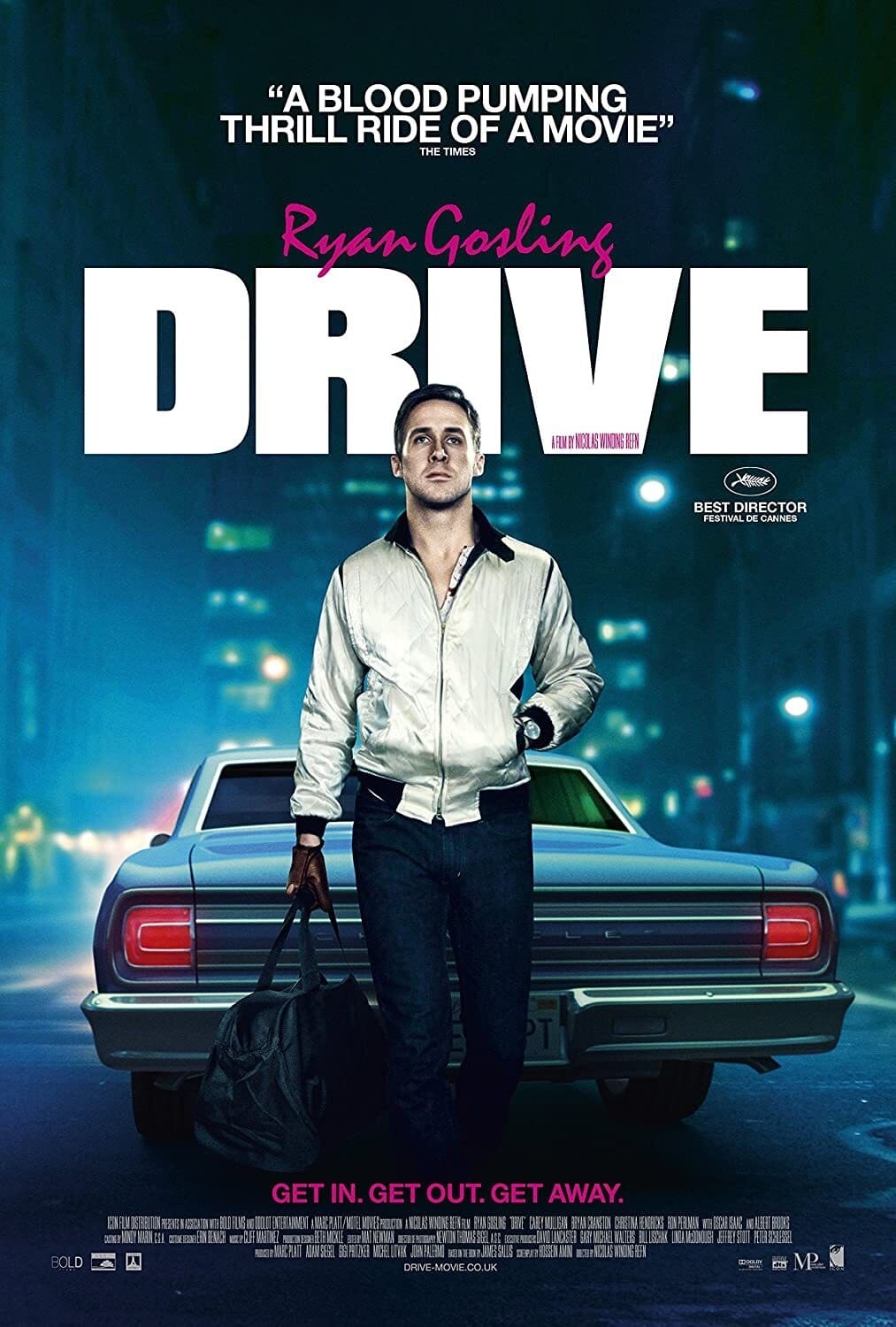
When Drive premiered at the Cannes Film Festival in 2011, it received a 15-minute standing ovation and earned director Nicolas Winding Refn the Best Director Award. This wasn’t just recognition for another Hollywood action film—it was acknowledgment of something far more ambitious. Drive operates on a wavelength entirely different from conventional thrillers, prioritizing atmosphere and character study over explosive set pieces.
The film follows an unnamed protagonist (Ryan Gosling), simply known as “Driver,” who works as a Hollywood stunt driver by day and a getaway driver for criminals by night. His carefully constructed world begins to unravel when he falls for his neighbor Irene (Carey Mulligan) and becomes entangled in a heist gone wrong involving her ex-convict husband Standard (Oscar Isaac).
What makes Drive extraordinary isn’t its plot—which follows familiar noir conventions—but how Refn and screenwriter Hossein Amini approach their material. Based on James Sallis’s 2005 novel, the adaptation strips away conventional exposition and dialogue-heavy scenes in favor of pregnant silences and meaningful glances. This minimalist approach forces viewers to lean into the film’s visual storytelling and atmospheric soundscape.
Ryan Gosling: The Art of Silent Performance
Ryan Gosling delivers one of his most compelling performances as the enigmatic Driver. Ever since his chilling young Jewish neo-Nazi in “The Believer” (2001), he has shown a gift for finding arresting, powerful characters. In Drive, Gosling embodies presence and sincerity while maintaining an almost mythical quality that recalls classic film archetypes.
As played by Ryan Gosling, he is in the tradition of two iconic heroes of the 1960s: Clint Eastwood’s Man With No Name and Alain Delon in “Le Samourai.” He has no family, no history and seemingly few emotions. The Driver communicates primarily through body language and facial expressions, making every gesture meaningful. Gosling transforms what could have been a one-note “strong silent type” into a complex study of masculinity, violence, and vulnerability.
The actor’s ability to convey deep emotions without relying on dialogue showcases his maturation as a performer. Where many actors might overcompensate for limited dialogue with exaggerated physical acting, Gosling maintains restraint that makes his character’s eventual violent outbursts all the more shocking and effective.
Carey Mulligan: Vulnerability and Strength
Carey Mulligan brings nuanced complexity to Irene, avoiding the typical “damsel in distress” or “femme fatale” archetypes common in noir films. Drive was the first film that British actress Carey Mulligan signed to do after being nominated for an Academy Award for her role in An Education (2009). Her casting proved inspired, as she creates genuine chemistry with Gosling despite their minimal dialogue.
His neighbor is Irene, played by Carey Mulligan, that template of vulnerability. She has a young son, Benecio (Kaden Leos), who seems to stir the Driver’s affection. Mulligan’s performance anchors the film’s emotional core, making the audience invest in her relationship with Driver even as we understand the inherent impossibility of their connection.
Originally, the character was a Hispanic woman named Irina. The character was changed to Irene after Mulligan was cast, demonstrating how Refn tailored the role to fit Mulligan’s particular screen presence and acting style.
Supporting Cast Excellence
The supporting cast elevates Drive beyond typical genre fare. Bryan Cranston, fresh from his breakthrough on Breaking Bad, brings lived-in authenticity to Shannon, the garage owner caught between loyalty and survival. Refn knew he wanted to cast Cranston, as he was a fan of his work in the TV series Breaking Bad.
Albert Brooks delivers a career-defining performance as Bernie Rose, the soft-spoken but deadly mobster. Brooks accepted the role to go against type, and because he loved that Bernie was not a cliché. His portrayal subverts expectations by presenting a villain who seems genuinely sad about the violence he must commit.
Christina Hendricks appears in a small but memorable role as Blanche, while Ron Perlman brings menace to the role of Nino. Oscar Isaac, in an early career role, creates sympathy for Standard despite his character’s poor decisions that set the tragic events in motion.
Visual Poetry: Cinematography and Design
Drive succeeds as both popular entertainment and art film largely due to its exceptional visual craftsmanship. Cinematographer Newton Thomas Sigel shot the film digitally using an Arri Alexa camera, creating abundant, evocative, intense images of Los Angeles that are not often seen.
Color as Character
The film’s use of color transcends mere aesthetic choice to become narrative element. Neon pinks and blues bathe Los Angeles in an otherworldly glow that suggests both romance and danger. The use of color is particularly striking, with neon hues that echo the 1980s while feeling contemporary and fresh.
Refn and Sigel create a Los Angeles that exists outside normal time—part 1980s fever dream, part contemporary urban landscape. Refn’s characters are almost always half covered in shadows, they will always stand in just the right part of the frame to make the frame as impactful as it can be.
The Elevator Scene: A Masterclass in Filmmaking
The famous elevator sequence represents Drive at its artistic peak. Every movie has to have a heart – a place where it defines itself – and in every movie I’ve made there’s always a scene that does that. On Drive, it was hard for me to wrap my head around it. I realized I needed to show in one situation that Driver is the hopelessly romantic knight, but he’s also completely psychotic and is willing to use any kind of violence to protect innocence.
When Irene faces a menacing situation, Driver reveals his darkest colors, and the love scene switches from beauty to violence in a fraction of second. The sequence demonstrates Refn’s ability to blend romance and violence in ways that feel both shocking and inevitable.
The Soundtrack: Defining a Generation
No discussion of Drive is complete without examining its iconic soundtrack, which has influenced countless films and artists in the decade since its release. The soundtrack was listed on Spin magazine’s list of 40 Movie Soundtracks That Changed Alternative Music.
Cliff Martinez and the Score
Composer Cliff Martinez created a score that perfectly complements the film’s retro-futuristic aesthetic. Martinez based his music, which was used in the movie, on the temporary score employed earlier in Drive’s production, as well as Jewel’s prior work that Refn wanted to be reflected in the theatrical cut of the film.
The music operates on multiple levels—supporting the action while creating an emotional landscape that guides viewer response. “This forces your brain to focus on the color and sound of the film more, which pushes the music and the cinematography to the front of the screen”.
Synthwave Revival
The soundtrack’s synthwave aesthetic helped revive interest in 1980s electronic music, influencing everything from video games to contemporary pop music. Key tracks include:
• “Nightcall” by Kavinsky – The opening track that perfectly establishes the film’s tone • “Under Your Spell” by Desire – Creates the romantic atmosphere between Driver and Irene • “Tick of the Clock” by Chromatics – Underscores key dramatic moments
It received positive responses and peaked the soundtrack list from Billboard and Official Charts Company, while also peaked at 30th position on the US Billboard 200.
Technical Mastery: Action Sequences
While Drive prioritizes atmosphere over action, its three major driving sequences showcase Refn’s understanding of practical filmmaking. Drive has three major car sequences, none of which, per the director’s wishes, features handheld shooting.
The Opening Heist
The film’s opening sequence establishes Driver’s professional competence while introducing the visual language Refn will employ throughout. Shot from Driver’s perspective, the sequence builds tension through restraint rather than spectacle.
Desert Chase
The film’s second major action sequence takes place in broad daylight in the desert, providing visual and tonal contrast to the nighttime L.A. sequences. The harsh lighting and open spaces reflect Driver’s increasingly desperate situation.
Final Confrontation
The climactic sequence strips away any romantic notions about Driver’s lifestyle, presenting violence as brutal and consequences as inescapable.
Thematic Depth: Violence and Redemption
Beneath its stylized surface, Drive grapples with serious themes about masculinity, violence, and the possibility of redemption. Driver represents a particular type of male fantasy—the strong, silent protector—while simultaneously deconstructing that archetype.
The Anti-Hero Question
Whatever happened to him drove any personality deep beneath the surface. He is an existential hero, I suppose, defined entirely by his behavior. Driver’s lack of backstory forces viewers to judge him solely on his actions, raising questions about moral judgment and the nature of heroism.
Violence as Communication
When Driver finally explodes into violence, Refn presents it as both shocking and inevitable. The film suggests that violence may be Driver’s only means of authentic expression, making his eventual isolation tragically appropriate.
Financial Performance and Cultural Impact
Drive proved that audiences were hungry for more challenging genre filmmaking. Drive achieved commercial success and wholesale praise, taking $76.2m worldwide, a commendable yield of roughly 500 per cent against its $15 million budget.
The film’s success extended far beyond traditional box office metrics. In our digital age, where financial planning often involves understanding diverse revenue streams, Drive demonstrates how a well-crafted film can generate lasting cultural value that extends far beyond its initial theatrical run.
The $15 million film ended up earning back its budget at least five-fold at the box office, proving that audiences were ready for more sophisticated approaches to genre filmmaking.
Critical Reception and Awards Recognition
Critical response to Drive was overwhelmingly positive, with many reviewers praising its unique approach to familiar material. Drive was Roger Ebert’s seventh-best film of 2011. In praising the film, he wrote, “Here is a movie with respect for writing, acting, and craft. It has respect for knowledgeable moviegoers”.
Festival Success
The film’s Cannes success established it as more than mere genre entertainment. Before its September 2011 release, Drive had been shown at film festivals, including the 2011 Cannes Film Festival, where it received a standing ovation. Refn won the festival’s Best Director Award.
Academy Recognition
Its honors include a nomination for Best Sound Editing at the 84th Academy Awards, acknowledging the film’s exceptional technical craftsmanship.
For those interested in comprehensive film analysis and industry insights, The Hollywood Reporter continues to provide authoritative coverage of the entertainment industry and its evolving landscape.
Legacy and Influence
More than a decade after its release, Drive continues to influence filmmakers, musicians, and visual artists. The film helped establish the “neon noir” aesthetic that has become ubiquitous in contemporary media, from video games to television series.
The Synthwave Renaissance
The soundtrack’s influence on contemporary music cannot be overstated. Chromatics – ‘Tick of the Clock’ cover art. Photo Credit: Italians Do It Better. Even so, it wasn’t just critics who loved it. The film helped launch the careers of numerous synthwave artists and established the genre as more than nostalgic pastiche.
Visual Influence
Drive‘s visual language—neon colors, retro typography, and stylized violence—has been endlessly imitated and referenced. The film’s poster design alone has spawned countless homages and parodies.
Final Verdict
Drive succeeds by refusing to be the film its marketing suggested. Instead of delivering conventional thrills, Refn created something far more interesting—a meditation on violence, loneliness, and the possibility of human connection in an increasingly disconnected world.
What Works: • Exceptional lead performances from Ryan Gosling and Carey Mulligan • Stunning cinematography that transforms Los Angeles into a dreamscape • An iconic soundtrack that redefined film music • Precise direction that never wastes a moment • Supporting performances that elevate familiar archetypes
What Doesn’t: • Extreme violence may alienate some viewers • Slow pacing requires patience from audiences expecting conventional action • Minimal dialogue may frustrate viewers seeking traditional character development • Stylistic choices occasionally overshadow narrative momentum
Conclusion: A Modern Classic
Drive stands as one of the most successful art-house genre films of the 2010s, proving that audiences hunger for more challenging entertainment when it’s presented with sufficient style and craft. Refn created a film that works simultaneously as a straight crime thriller and as an artistic statement about cinema’s power to transform familiar stories into something transcendent.
Like the best noir films, Drive uses its genre framework to explore deeper themes about masculinity, violence, and the price of isolation. The result is a film that rewards multiple viewings while maintaining its emotional impact and visual power.
Rating: ★★★★½
Drive represents everything great about contemporary independent cinema—artistic ambition backed by technical excellence and anchored by committed performances. It’s a film that respects its audience’s intelligence while delivering the visceral pleasures of great genre filmmaking. More than just entertainment, it’s a work of art that continues to reveal new layers with each viewing.
For viewers seeking challenging cinema that doesn’t sacrifice style or entertainment value, Drive remains essential viewing. It’s a film that changed how we think about action movies, soundtracks, and the possibilities of genre filmmaking in the 21st century.
Leave a Reply