
Fawlty Towers (1979) Complete TV Review
Fawlty Towers (1979) Complete TV Review
The Pinnacle of British Comedy Excellence
In the pantheon of British television comedy, few shows have achieved the legendary status of Fawlty Towers. Created by John Cleese and Connie Booth, this masterpiece of situational comedy ran for just twelve episodes across two series in 1975 and 1979, yet its impact on television history remains unparalleled. The show was ranked first on a list of the 100 Greatest British Television Programmes drawn up by the British Film Institute in 2000, and in a 2001 poll conducted by Channel 4, Basil Fawlty was ranked second (to Homer Simpson) on their list of the 100 Greatest TV Characters.
The genius of Fawlty Towers lies not just in its brilliant writing, but in its perfect understanding of farcical comedy timing and character development. Set in the fictional seaside hotel in Torquay, the series follows the chaotic misadventures of Basil Fawlty and his long-suffering staff as they attempt to run what could generously be described as the worst-managed hotel in Western Europe.
Cast and Character Analysis
John Cleese as Basil Fawlty
John Cleese has created one of the defining characters of comedy in Basil Fawlty. The neurotic, snobbish, and perpetually frustrated hotel owner represents the pinnacle of British comedy characterization. Cleese’s physical comedy prowess, honed through his years with Monty Python, finds its perfect outlet in Basil’s explosive outbursts and increasingly desperate attempts to maintain his delusions of grandeur.
Key character traits: • Pathological inability to provide good customer service • Deep-seated class anxieties and social climbing aspirations
• Explosive temper triggered by the smallest inconveniences • Remarkable capacity for making simple situations catastrophically complex
Prunella Scales as Sybil Fawlty
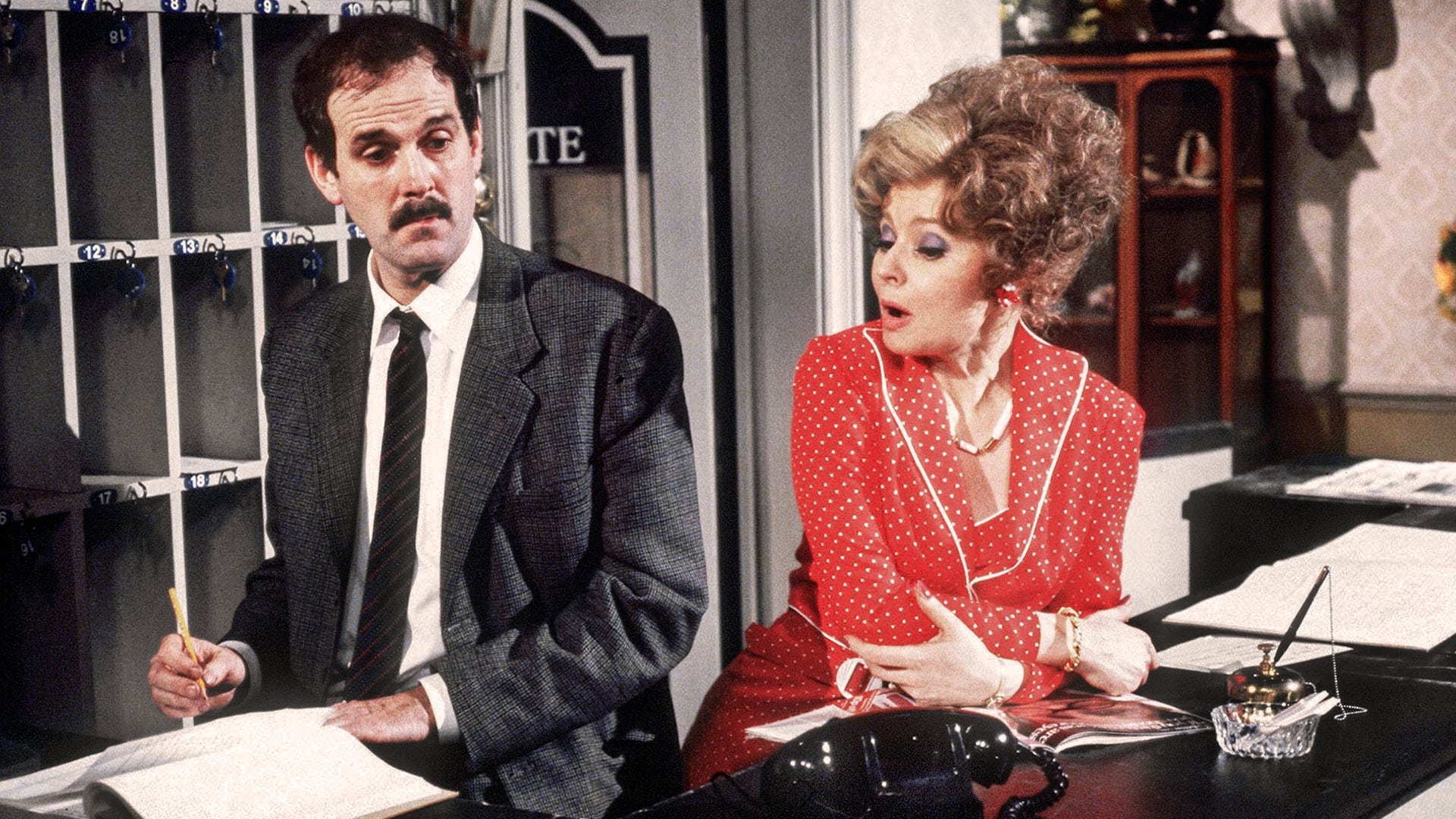
Sybil Fawlty, played by Prunella Scales, is Basil’s wife. Energetic and petite, she prefers a working wardrobe of tight skirt-suits in shiny fabrics and sports a tower of permed hair augmented with hairpieces and wigs necessitating the use of overnight curlers. Scales delivers a masterclass in comedic timing as the sharp-tongued Sybil, who serves as both Basil’s business partner and his most formidable adversary.
Prunella Scales (born June 22, 1932) brought decades of theatrical experience to the role of Sybil. Her career break came with the early 1960s sitcom Marriage Lines starring opposite Richard Briers. She played her most famous role, Sybil Fawlty in the sitcom Fawlty Towers, over two series in 1975 and 1979. Her portrayal of the domineering yet somehow patient wife earned critical acclaim and cemented her place in British comedy history.
Despite Basil’s increasingly creative insults for his wife – including such gems as “that golfing puff-adder” and “my little piranha fish” – Scales imbues Sybil with an underlying strength that makes their dysfunctional marriage believable and, oddly, endearing.
Supporting Cast Excellence
Connie Booth as Polly Sherman delivers the voice of reason amidst the chaos. As the competent chambermaid with artistic aspirations, Booth provides the perfect counterbalance to the hotel’s dysfunction while often becoming reluctantly complicit in Basil’s increasingly elaborate schemes to cover up his mistakes.
Andrew Sachs as Manuel created one of television’s most memorable characters in the confused Spanish waiter from Barcelona. While some modern critics have questioned certain aspects of the character’s portrayal, Sachs’s performance remains a study in physical comedy and timing that influenced generations of performers.
Production Values and Technical Excellence
Writing and Script Quality
Cleese said one of the reasons the series worked so well was the quality of the scripts and the care taken over the editing. He told a TV interviewer that while the average BBC half-hour comedy script had 65 pages, the ones for Fawlty Towers had between 135 and 140 pages.
This attention to detail manifested in several key areas:
- Dialogue Precision: Every line serves multiple purposes – advancing plot, revealing character, and generating laughs
- Structural Perfection: Each episode follows a carefully constructed arc from minor inconvenience to complete catastrophe
- Character Consistency: Despite the farcical situations, each character remains true to their established personality
- Thematic Coherence: The hotel setting provides endless opportunities for the collision of British class consciousness with service industry realities
Direction and Editing
“We literally did twice as many camera cuts—average shows got 200, we used to have 400. So there was an enormous amount in there… We did anything between 20 and 25 hours editing each show.” This meticulous approach to post-production created the tight pacing that makes Fawlty Towers so rewatchable.
The series benefited from two distinct directorial approaches: • Series 1 (1975): Produced and directed by John Howard Davies • Series 2 (1979): Produced by Douglas Argent and directed by Bob Spiers
Cultural Impact and Legacy
Critical Reception
Fawlty Towers received widespread critical acclaim from its initial broadcast. The Sunday Times called it “the funniest sitcom in years”. Clive James writing in The Observer said the second episode had him “retching with laughter.” Peter Fiddick also championed Fawlty Towers in The Guardian, calling it “the undoubted hit even of a season with a lot of comedy on show” and “one of the most amazingly funny programmes to come out of any television”.
The series maintains perfect scores across rating platforms, On Rotten Tomatoes, Fawlty Towers has an aggregate score of 100% based on 14 critic reviews.
Influence on Modern Comedy
The impact of Fawlty Towers extends far beyond its modest twelve-episode run. Ricky Gervais and Stephen Merchant refused to make a third series of either The Office or Extras, citing Fawlty Towers’ short lifespan. Rik Mayall, Ben Elton and Lise Mayer, the writers behind The Young Ones, which also ran for only two series (each with six episodes), used this explanation as well. Victoria Wood also indicated this influenced her decision to limit dinnerladies to 16 episodes over two series.
This philosophy of “quit while you’re ahead” has become known as the Fawlty Towers principle in television production – the idea that maintaining quality is more important than maximizing quantity.
International Recognition
The series has achieved global recognition, consistently appearing on international “best of” lists and continuing to find new audiences decades after its original broadcast. In 2019, it was named the greatest-ever British TV sitcom by a panel of comedy experts compiled by the Radio Times.
Episode Analysis and Memorable Moments
Series Structure and Themes
Fawlty Towers operates on a deceptively simple premise: what happens when someone utterly unsuited for hospitality runs a hotel? Each episode follows a similar structure:
- Setup: A seemingly routine hotel situation arises
- Complication: Basil’s interference makes things worse
- Escalation: Misunderstandings multiply exponentially
- Climax: Complete chaos ensues
- Resolution: Order is temporarily restored, usually despite Basil rather than because of him
Standout Episodes
While every episode of Fawlty Towers maintains exceptionally high standards, several have achieved iconic status:
“The Germans” (Series 1): Perhaps the most quoted episode, featuring Basil’s infamous “Don’t mention the war!” outburst and his increasingly frantic attempts to avoid offending German guests.
“Gourmet Night” (Series 1): Showcases the series’ ability to escalate a simple dinner service into complete pandemonium when the chef becomes incapacitated.
“The Psychiatrist” (Series 2): Features complex plotting as Basil attempts to cover up a guest’s romantic liaison while dealing with his own paranoid assumptions.
Physical Comedy Mastery
The series showcases some of television’s finest physical comedy, with Cleese’s considerable height and background in physical performance creating memorable visual gags. From the infamous car-beating scene to Manuel’s various mishaps, the physical humor complements rather than overshadows the verbal wit.
Technical and Artistic Merits
Set Design and Atmosphere
The hotel set itself becomes almost a character in the series. The cramped spaces, garish décor, and impractical layout perfectly reflect the establishment’s fundamental dysfunction while providing natural comedy opportunities through spatial relationships and sightlines.
Costume and Character Design
Each character’s appearance perfectly communicates their personality: • Basil’s ill-fitting suits suggest his pretensions exceeding his means • Sybil’s elaborate hairstyles and bright clothing reflect her determination to maintain appearances
• Polly’s practical attire emphasizes her competence • Manuel’s slightly disheveled uniform mirrors his perpetual confusion
Sound Design and Music
The series makes excellent use of sound effects to enhance comedic timing, from Manuel’s crashes in the kitchen to the hotel’s creaking infrastructure. The understated musical scoring allows the dialogue and physical comedy to remain the focus.
Contemporary Relevance and Modern Viewing
Accessibility for New Audiences
Despite being nearly five decades old, Fawlty Towers remains remarkably accessible to contemporary viewers. The universal themes of workplace dysfunction, marital discord, and service industry challenges transcend cultural and temporal boundaries.
For those interested in understanding the evolution of comedy and entertainment value over time, exploring content on platforms that analyze media trends and cultural impact, such as HablemosMoney, provides valuable context for appreciating how certain shows maintain their relevance across generations.
Educational Value
Fawlty Towers serves as an excellent study in: • Comedy Writing: Demonstrating how to construct jokes that work on multiple levels • Character Development: Showing how to create flawed but engaging characters • Pacing and Timing: Illustrating the importance of rhythm in comedy • British Cultural History: Providing insight into 1970s British social attitudes and class consciousness
The series continues to be studied in film schools and comedy writing courses worldwide as an example of perfectly constructed situational comedy.
Streaming and Availability
Modern Distribution
Fawlty Towers remains widely available across multiple platforms, ensuring new generations can discover this comedy masterpiece. The series has been carefully remastered for modern viewing, with enhanced picture quality that brings out details that may have been missed in original broadcasts.
Cultural Preservation
The BBC’s commitment to preserving and promoting classic British comedy ensures that Fawlty Towers continues to reach new audiences. The corporation’s digital initiatives have made the series more accessible than ever while maintaining the integrity of the original vision.
Behind the Scenes: Production Insights
Creative Partnership
The collaboration between John Cleese and Connie Booth proved instrumental to the series’ success. Booth and Cleese married in 1968 and have one daughter, Cynthia Cleese, who went on to act alongside her father in the comedy films A Fish Called Wanda (1988) and Fierce Creatures (1997). Their personal relationship informed the authentic dynamics between the hotel staff, while their professional partnership created some of television’s most memorable scripts.
Real-World Inspiration
The series drew inspiration from the creators’ actual experiences. The hotel that inspired Fawlty Towers is now part of the Best Western franchise. This grounding in reality gave the show an authenticity that elevated it above pure farce into the realm of recognizable human behavior, albeit exaggerated for comedic effect.
Production Challenges
The gap between the two series reflected both the creators’ perfectionism and the BBC’s production constraints. The second series was transmitted three-and-a-half years later, with the first episode being broadcast on 19 February 1979. Due to an industrial dispute at the BBC, which resulted in a strike, the final episode was not completed until well after the others, being finally shown as a one-off instalment on 25 October 1979.
Awards and Recognition
Industry Accolades
Fawlty Towers received significant recognition from the television industry:
• BAFTA Awards: Three British Academy Television Awards (BAFTAs) were awarded to people for their involvement with the series. Both of the series were awarded the BAFTA in the category Best Scripted Comedy, the first being won by John Howard Davies in 1976, and the second by Douglas Argent and Bob Spiers in 1980.
• Individual Recognition: In 1980, Cleese received the British Academy Television Award for Best Entertainment Performance.
Long-term Cultural Impact
The series’ influence extends well beyond awards, fundamentally changing expectations for British television comedy and establishing new standards for writing and performance quality in the sitcom format.
Future Prospects and Legacy Continuation
Modern Adaptations
In 2016, Cleese reprised his role as Basil in a series of TV adverts for High Street optician chain Specsavers. The same year, Cleese and Booth reunited to create and co-write the official theatrical adaptation of Fawlty Towers, which premiered in Melbourne at the Comedy Theatre.
Recent developments suggest continued interest in the property: As of 2023 a reboot of the series is in the works, and Cleese and his daughter Camilla Cleese are set to write and act in it.
Contemporary Stage Productions
When Fawlty Towers first aired on the BBC in 1975, few could have predicted it would cement itself as a cornerstone of British television… Fast-forward to the present day, and Cleese continues to champion the show’s timeless humour, bringing it to the stage for new generations to enjoy.
Conclusion: A Timeless Masterpiece
Fawlty Towers stands as perhaps the finest example of British situational comedy, a perfect storm of brilliant writing, exceptional performances, and meticulous production values. Its influence on comedy writing continues to be felt decades after its original broadcast, while its characters remain as vivid and entertaining as ever.
The series demonstrates that true quality transcends quantity – twelve perfect episodes have proven more valuable and enduring than hundreds of lesser efforts. In an era of endless content production, Fawlty Towers serves as a reminder that careful craftsmanship and attention to detail create lasting artistic value.
Final Recommendations
Who Should Watch: • Comedy enthusiasts seeking to understand the foundations of modern British humor • Students of television writing and production • Anyone interested in perfectly constructed character-driven storytelling • Viewers looking for comedy that rewards multiple viewings
Viewing Approach:
- Watch episodes in order for maximum character development appreciation
- Pay attention to the intricate plotting and setup/payoff structures
- Notice the careful balance between verbal wit and physical comedy
- Appreciate the series as a complete artistic statement rather than individual episodes
Rating: ★★★★★
Fawlty Towers earns a perfect rating not just for its entertainment value, but for its profound influence on television comedy and its sustained relevance across generations. It remains the gold standard against which all other British sitcoms are measured, a testament to the power of vision, craft, and collaborative excellence in television production.
Whether you’re discovering these characters for the first time or revisiting old favorites, Fawlty Towers offers rewards that deepen with each viewing. In the landscape of modern television, where content often prioritizes quantity over quality, this modest twelve-episode series stands as an enduring reminder of what can be achieved when creativity, talent, and perfectionism align in perfect harmony.
Leave a Reply