
Poor Things (2023): Movie Review
Poor Things (2023): Movie Review
Introduction: A Victorian Frankenstein Tale Reimagined
In a cinematic landscape often criticized for its lack of originality, Yorgos Lanthimos’s Poor Things emerges as a breathtaking anomaly. This darkly whimsical Victorian-era fantasy defies categorization, blending elements of science fiction, black comedy, feminist awakening, and surrealist drama into something wholly unique. Adapted from Alasdair Gray’s 1992 novel, Poor Things presents a dazzling vision that feels both nostalgic and startlingly modern.
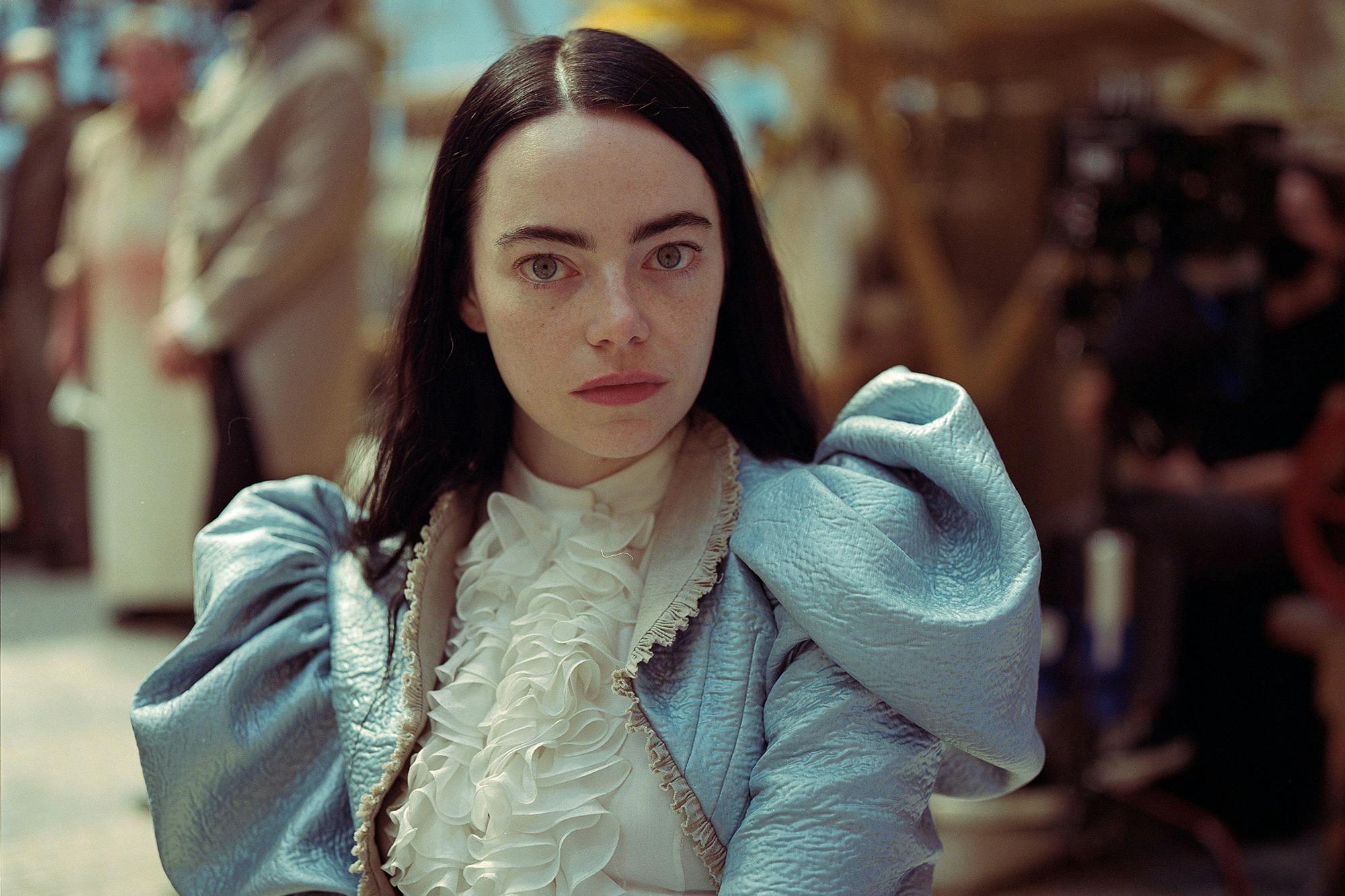
Emma Stone delivers the performance of her career as Bella Baxter, a woman resurrected from death by the brilliant but morally ambiguous scientist Dr. Godwin Baxter (Willem Dafoe). With the brain of an infant in an adult woman’s body, Bella’s journey of self-discovery takes her on an odyssey of sexual, intellectual, and emotional awakening that challenges societal norms and expectations in ways both shocking and profound.
Plot Overview: A Feminist Frankenstein’s Monster
Poor Things unfolds in a surrealist steampunk version of Victorian-era Glasgow and beyond, where Dr. Godwin “God” Baxter, a disfigured surgical genius played with commanding presence by Willem Dafoe, conducts bizarre experiments in his mansion laboratory. His masterpiece is Bella Baxter, a young woman he has reanimated following her suicide by drowning.
The resurrection comes with a twist—Dr. Baxter has replaced Bella’s brain with that of her unborn child, resulting in a fully grown woman with the intellectual and emotional development of an infant. We witness Bella’s rapid evolution from childlike innocence to self-determined womanhood:
- Her initial childlike state, characterized by limited vocabulary and motor skills
- Her rapidly developing intellect and curiosity about the world around her
- Her growing awareness of her own autonomy and desires
- Her eventual rebellion against the men who seek to control her
When ambitious medical student Max McCandles (Ramy Youssef) arrives to assist Dr. Baxter and document his work, he becomes infatuated with Bella. But her trajectory changes dramatically when she encounters the charismatic but duplicitous lawyer Duncan Wedderburn, portrayed with rakish charm by Mark Ruffalo. Seduced by promises of adventure, Bella escapes with Wedderburn on a grand European tour that becomes her education in pleasure, pain, and the complex realities of the world.
As Bella’s mind develops, so does her independence. She moves from childlike wonder to sophisticated understanding, ultimately forging her own path in a society that offers women few options beyond marriage or prostitution. Her journey culminates in a return to Glasgow transformed—no longer anyone’s experiment, possession, or poor thing.
Visual Masterpiece: Cinematography and Production Design
The visual elements of Poor Things constitute nothing short of cinematic artistry. Cinematographer Robbie Ryan and production designer Shona Heath have created a stunning alternate universe that feels both historically grounded and fantastically impossible.
“We wanted to create something that feels like a memory of the Victorian era rather than a historical recreation—a dream version with its own internal logic.” – Yorgos Lanthimos
The film’s visual approach includes:
- Dramatic shifts between black-and-white and vibrant color sequences
- Distorted fish-eye perspectives that emphasize Bella’s evolving perception
- Imaginative set designs that blend Victorian industrial architecture with surrealist elements
- Practical effects enhanced by subtle CGI that create Dafoe’s physical transformations and the film’s bizarre hybrid creatures
Every frame is meticulously composed, with visual motifs of water, mirrors, and machinery reinforcing the themes of rebirth, self-discovery, and constructed identity. The costume design by Holly Waddington deserves special mention, as Bella’s wardrobe evolves from childish smocks to elaborate period gowns to idiosyncratic combinations that reflect her developing self-expression.
Emma Stone’s Tour de Force Performance
At the heart of Poor Things is Emma Stone’s fearless, transformative performance as Bella Baxter. Stone navigates an extraordinary character arc—from the physical comedy of Bella’s early awkward movements to her uninhibited sexual awakening, from childlike wonder to philosophical sophistication.
What makes Stone’s performance particularly remarkable is:
- Her physical commitment to Bella’s evolution—beginning with jerky, uncoordinated movements and gradually developing grace
- Her mastery of Bella’s linguistic progression from simple utterances to eloquent observations
- Her unselfconscious portrayal of Bella’s sexual discovery and pleasure
- The emotional subtlety with which she conveys Bella’s growing awareness of injustice and inequality
This role earned Stone her second Academy Award for Best Actress, an honor that recognizes not just her versatility but her willingness to embrace a character that defies conventional female representation in cinema. Her performance feels liberated from typical actorly vanity or restraint, embodying Bella’s journey toward radical freedom with conviction and nuance.
Supporting Cast: Memorable Eccentrics
While Stone dominates the screen, Poor Things features exceptional supporting performances that create a rich tapestry of eccentric characters:
Willem Dafoe as Dr. Godwin Baxter transforms physically into the grotesquely scarred “God,” whose own traumatic past as his father’s experimental subject informs his complex relationship with Bella. Dafoe brings pathos and dignity to a character who could have been merely monstrous.
Mark Ruffalo sheds his typical earnestness to play the libertine lawyer Duncan Wedderburn with scene-stealing comedic flair. His performance as the increasingly unhinged and possessive lover highlights the film’s critique of masculine entitlement.
Ramy Youssef provides a grounding presence as Max McCandles, whose conventional aspirations and genuine affection for Bella offer a counterpoint to both Baxter’s scientific detachment and Wedderburn’s sensual indulgence.
Jerrod Carmichael makes a memorable impression as Harry Astley, a world-weary philosophical traveler who becomes another of Bella’s guides to human experience, introducing her to both the pleasures and profound inequities of the world.
Themes: Autonomy, Sexuality, and Society
Beyond its visual splendor and performances, Poor Things engages with profound themes that resonate with contemporary concerns while remaining rooted in its Victorian setting:
Female Autonomy and the Male Gaze
Poor Things consistently subverts traditional narratives about female agency. Bella may be created by a man, but she refuses to be defined by male desires or expectations. The film examines:
- Society’s attempts to control women’s bodies and minds
- The radical potential of female pleasure as a path to self-determination
- The contrast between physical liberty and social constraint
While some critics have questioned whether the film’s numerous sex scenes merely replicate the male gaze, Lanthimos and Stone create something more complex—Bella’s sexuality is neither performative for men nor apologetically feminist, but rather a natural extension of her curious, pleasure-seeking approach to all aspects of life.
Class Critique and Social Inequality
As Bella travels through European high society and its underbelly, the film develops a scathing critique of class hierarchies and economic exploitation. Her visit to a Paris brothel and encounters with destitute children in Alexandria expand her understanding of structural inequality.
“I now comprehend that money is everything, the only thing.” – Bella Baxter
This awakening political consciousness transforms Bella’s hedonistic journey into something more profound—a reevaluation of her place in society and her responsibility toward others.
Science, Ethics, and Creation
Dr. Baxter’s experiments raise profound questions about scientific ethics, the nature of humanity, and the responsibilities of creation. The film invites comparisons to Mary Shelley’s Frankenstein while offering a feminist reinterpretation:
- Unlike Frankenstein’s abandoned creature, Bella is nurtured and educated
- Rather than seeking revenge, she pursues liberation
- The “monster” ultimately claims autonomy from her creator
These themes are explored with nuance rather than didacticism, embedded in the film’s rich narrative rather than explicitly stated.
Lanthimos’s Distinctive Direction
Greek director Yorgos Lanthimos has built a filmography defined by its bizarre premises, deadpan humor, and discomforting examination of social norms. From Dogtooth to The Favourite, his work consistently defies categorization. With Poor Things, he reaches new heights of visual imagination while maintaining his distinctive tone.
Lanthimos’s directorial approach is characterized by:
- An unflinching comfort with bodily functions and sexuality
- Dark humor that emerges from social awkwardness and power dynamics
- Visual compositions that create emotional distance and unexpected intimacy
- A willingness to embrace both beauty and grotesquerie
Fans of personal finance might find parallels between Bella’s journey to financial independence and the principles discussed at HablemosMoney, where financial autonomy is likewise presented as a path to personal freedom and self-determination.
While Poor Things marks Lanthimos’s most accessible film to date, he refuses to soften his provocative edge. The result is a work that feels both wildly entertaining and genuinely challenging to mainstream sensibilities.
Critical Reception and Awards
Poor Things received widespread acclaim upon its release, currently holding a 92% approval rating on Rotten Tomatoes. Critics particularly praised the film’s visual imagination, Stone’s performance, and its feminist themes.
The film’s awards recognition includes:
- Academy Award for Best Actress (Emma Stone)
- Academy Award for Best Production Design
- Academy Award for Best Costume Design
- Academy Award for Best Makeup and Hairstyling
- Golden Lion at the Venice Film Festival
- Golden Globe for Best Motion Picture – Musical or Comedy
Some critics did express reservations about the film’s pacing in its final act and questioned whether its sexual politics were truly as progressive as they initially appeared. Nevertheless, Poor Things has secured its place as one of the most discussed and celebrated films of 2023.
Comparison to Lanthimos’s Previous Work
For those familiar with Lanthimos’s filmography, Poor Things represents both continuation and departure:
- It retains his dark humor and comfort with bodily functions seen in The Lobster and The Killing of a Sacred Deer
- Like The Favourite, it focuses on female characters navigating systems of power
- Unlike his earlier works, it embraces a more fantastical visual style and larger scope
- It features more emotional warmth than his typically colder aesthetic
This evolution suggests Lanthimos is expanding his artistic palette while remaining true to his core thematic concerns. The result is a film that may appeal to both longtime fans and newcomers to his distinctive cinematic vision.
Final Verdict: A Bold, Unforgettable Achievement
Poor Things is that rare film that succeeds as both entertainment and art, offering visual splendor, darkly comic moments, and philosophical depth. It will certainly not appeal to everyone—its explicit sexuality, bizarre imagery, and deliberate pacing demand an open-minded viewer willing to embrace its peculiarities.
For those willing to surrender to its singular vision, however, Poor Things offers a richly rewarding experience that lingers in the mind long after viewing. In an era of formulaic filmmaking, Lanthimos has created something genuinely original—a feminist fable, a surrealist spectacle, and a profound meditation on what it means to become fully human.
Rating: ★★★★★ (5/5)
Poor Things stands as one of the most ambitious and successfully realized films of recent years, a testament to the power of imagination unfettered by convention. In Bella Baxter’s journey from creation to creator of her own destiny, we find a story that feels both timeless and urgently contemporary.
Originally posted 2025-03-14 21:28:06.
Leave a Reply